Senior immersive media design major Holden Denyer connects digital experiences with the physical world.
At the University of Maryland’s annual spring open house called Maryland Day, senior immersive media design major Holden Denyer shared with visitors Odonata Odyssey, an educational video game he created that guides players through the full life cycle of a dragonfly from its point of view with just a few clicks.

Denyer handcrafted an arcade cabinet to house the game and custom-built physical buttons to curate a tangible learning experience for players at the event. Odonata Odyssey teaches players that dragonflies spend most of their lives underwater as aquatic predators before emerging as the familiar flying insects people recognize.
“Interacting with the game physically allowed facts and lessons to implant more thoroughly into their thought processes,” Denyer explained. “It wasn’t just a straightforward lecture or a brief show-and-tell. People were able to put themselves in a different perspective and learn in a very different yet still effective way.”
The game’s success last year at Maryland Day made it unsurprising that Entomology Professor Bill Lamp’s team brought it back in 2026 for visitors to the Plant Sciences Building. Denyer also created a web browser version of the game to increase accessibility for those who couldn’t make it to campus or who wanted to play the game again on their own.
“This project is an example of what I think technology should create; the game doesn’t replace real-world experiences but deepens them instead,” Denyer said. “That’s my goal, blending logical thinking and tech with artistic expression and creativity. UMD’s IMD program helped me develop the skills needed to do just that and now it feels like home.”
Investigating insects with interactive gaming
Denyer’s path to creating Odonata Odyssey started in a biological sciences classroom. He first became interested in entomology after taking an elective course, BSCI 145: “The Insect Apocalypse: Real or Imagined?” with Lamp.
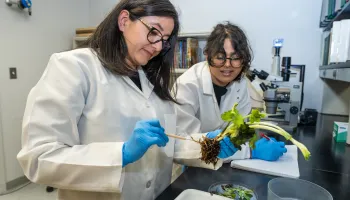
Fascinated by what he learned, Denyer pursued a summer research internship with the U.S. Department of Agriculture through the Resilience Climate Adaptation Program (RCAP), which was affiliated with the Lamp lab. There, he assisted graduate student researcher Robert Salerno (M.S. ’25, entomology) in studying the crucial role arthropods play in maintaining agricultural health. Denyer personally designed the 3D model for the bait lamina strips—strips inserted into soil to measure the feeding activity of soil invertebrates—used in their experiments. He also oversaw the production of several hundred units 3D-printed on campus, watching his design go from a digital file to physical tools used in real scientific research. Denyer’s bait lamina strips were used to closely monitor soil health in Maryland agricultural fields, gauging the effects of pesticides, fertilizer and land use (crop monocultures, soil tillage and aeration techniques, etc.) on beneficial insects hiding in the ground.
“I worked closely with farmers, helping them know about more efficient agricultural processes involving how they work with their soil that could be economically beneficial to them as well,” Denyer explained. “Translating the data and numbers into practice, helping them and the environment, showed me that I could make a difference using both science and creative thinking.”
That intersection of science and communication led Denyer back to Lamp’s lab to develop Odonata Odyssey and other ways to bring the wonders of insect biology to the public. He continues to assist with bait lamina testing, helping to communicate complex data to farmers and other stakeholders with his expertise.
Following his graduation in May, Denyer plans to work in museum and interactive exhibit design at organizations and production firms where education is front and center. For Denyer, Odonata Odyssey’s continued success is proof of concept for the career he wants to build. He hopes to create more digital tools that draw people closer to the natural world.
“There’s an important place in between interacting with the world around us and a digital screen,” Denyer said. “That spot in between those two things is like a golden zone—that's the goal I have in my mind.”