
Pollinator Science & Apiculture
Pollinators are critical components of both agricultural and ecological landscapes, so understanding their ecology and the causes of recent declines is important in conserving the pollination services they provide along with their incredible diversity. Several faculty in the Entomology Department study honey bees and other pollinators from a variety of scientific perspectives, not only to build on our knowledge of their ecology but also to provide the most up-to-date, relevant, research-based information to stakeholders.
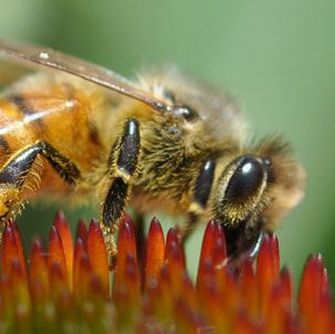 Honey bees are very important pollinators for a variety of fruit, vegetable, nut, and other specialty crops, providing pollination services valued at over $15 billion in the United States alone. One in every three bites you eat is pollinated either directly or indirectly by an insect pollinator. Honey bees are the most common and most heavily managed insect pollinator.
Habitat loss or land use changes are among the main drivers of declines in bee populations - especially ground nesting species - as well as those of other pollinators. Environments heavily shaped by human activity typically have one or more of the following characteristics: reduced native floral abundance and diversity, regular disturbance to soil, greater exposure to toxins, an increase of non-permeable surfaces, and/or lack of connectivity. These disturbance typically take place over relatively short historical time scales; however, there is evidence that long-term environmental changes have affected the relationships between plants and their pollinators.
Ongoing work in the Department of Entomology on the ecology and management of pollinators includes:
- Colony Loss & Management Surveys. In partnership with USDA, the vanEngelsdorp Lab administers three surveys as part of a nationwide colony health questionnaire for beekeepers managing apiaries, which together produce the largest data set of managed honey bee colony health in the country.
- The Colony Loss Survey monitors colony losses throughout the country to observe trends of honey bee mortality from year-to-year.
- The National Management Survey takes an epidemiological approach to acquire a greater understanding of the effects of various colony management practices and their relationship with colony health.
- The National Honey Bee Survey is a comprehensive examination of colony health throughout apiaries in the U.S. This survey takes an epidemiological approach to document honey bee diseases, pests, and pathogens. This survey also monitors the presence or absence of invasive threats to honey bee colonies as well as pesticides present in honey bee hives.
- The Last Week in the Apiary is a program inspired by years of helping beekeepers monitor their colonies and management practices. A big lesson from that work is all beekeeping is local, and beekeeping requires a time. It is easy to forget and delay management practices, and the aim of this program is to provide weekly reminders to beekeepers about what we are doing, in the hope that it will act as a prompt or reminder to other MD and surrounding state beekeepers that they should probably be doing the same thing soon.
- Plant-Pollinator Phylogenetics & Phylogeography. Previous studies have demonstrated that species reacted to historic environmental disturbances like glaciation and tectonic events, but how interactions respond to such events is less well understood. Under strong environmental pressure, interacting organisms can be expected to respond in a concerted manner, since they rely on each other to survive. The Espindola Lab uses phylogenetic, phylogeographic, and species distribution models to understand the spatial histories of plants and their pollinators, and identify how these organisms react to strong environmental disturbances over historic time scales.
Related News

Connected Researchers