
Integrated Pest Management and Biological Control of Agricultural, Urban & Forest Pests
The Department of Entomology has been a leader in developing research, extension, and teaching programs to address the pest management needs of diverse clientele in rapidly urbanizing areas. The combination of high population density and pesticide use raise concerns regarding the exposure to humans and non-target organisms in these environments. Moreover, the rapid development of residential property in within the Chesapeake Bay watersheds creates a need to find methods that will reduce inputs of pesticides and nutrients into homes, schools, landscapes, and recreational areas.
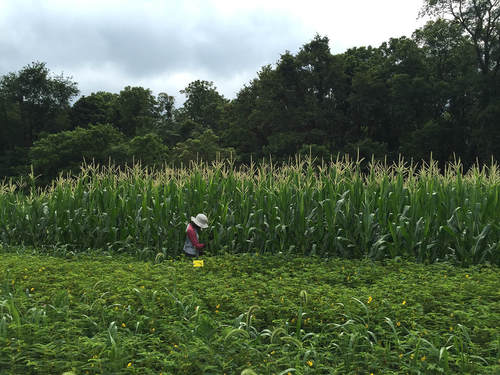 Entomology Department research and extension programs fall into several categories, and many projects involve experts in plant pathology, weed science, and nematology from the College of Agriculture and Natural Resources, local government agencies, and the private sector. Results of these investigations are disseminated routinely to stakeholders, and the general public via farm tours, conferences, videos, and newsletters in partnership with local commodity groups and government agencies.
Pest Management
- Major emphasis is placed on pest management strategies for use in corn, soybeans, small grains, forage crops, vegetables, and beekeeping. With the introduction of transgenic crops, for example, Entomology Department faculty have taken a leadership role in evaluating benefits and potential uses of this new technology, assessing its potential impact on non-target organisms, and developing resistance management strategies. Other applied projects focus on control strategies for new and emerging pests, insecticide application strategies for reducing cost and selection pressure, monitoring and detection of pest resistance, biological control through conservation and landscape design, insecticide efficacy and environmental fate studies, and management of mite pests of honeybees.
- Basic research is ongoing in the areas of host plant resistance, plant-insect interactions, biology of new pest species, plant-mediated resistance, ecology and behavior of natural enemies, isolation of bioactive substances from microbial symbionts of insects, and the identification and incorporation of genes from entomopathogenic fungi into plants.
Organic Agriculture & Soil Health
- The Entomology Department has a number of research projects that address the assorted needs of organic stakeholders. Organic crops face many challenges from insect, disease, and weed pests which cannot be met with conventional methods such as pesticides and genetically modified varieties. Maintaining soil quality and health and mitigating problems associated with crop pests are principal concerns of organic land managers.
- Entomology Department faculty and their collaborators investigate cover cropping, reduced tillage, trap cropping, and crop rotation techniques with the goal to improve the productivity, sustainability, and profitability of organic farms and those transitioning to organic production. Soil biodiversity, beneficial and pest arthropods, weed and weed seedbank densities are monitored to determine how different cultural practices impact organic cropping systems.
Pesticides
- Agricultural and urban pesticides have the potential for environmental contamination if proper application practices are not followed. Decreasing pesticide exposure can be accomplished through improving applicator education and formulation of sound policies. New and emerging problems such as development of pesticide resistance and human and environmental safety concerns also shape the direction of Entomology Department research and extension programs geared towards pesticide safety and education. The Entomology Department is one of the principal sources of training, educational materials, and programs for private and commercial pesticide applicators in the region.
Related News
Connected Researchers