Postdocs bring valuable expertise, national prestige and additional research funding to UMD.
Behind many breakthrough papers and discoveries at the University of Maryland is a community of dedicated researchers working behind the scenes: our postdoctoral scholars. In celebration of National Postdoc Appreciation Week, we are spotlighting some of the early-career scholars whose work drives our campus research enterprise forward.
The stories featured below offer a glimpse into the diverse, high-impact research being conducted across the College of Computer, Mathematical, and Natural Sciences by postdoctoral associates every day.
Studying the ‘Wild West’ of the Early Universe
Erini Lambrides is a postdoctoral fellow at NASA's Goddard Space Flight Center and UMD’s Department of Astronomy, where she studies how supermassive black holes form, grow and shape galaxies. Outside the lab, she spearheads programs that create pathways for students from all walks of life to become astrophysicists. Her work earned her a spot this summer on Scientific American's Young American Scientists list, which recognized 28 leading early-career researchers.
“You can do kick-ass science and care about the culture in astronomy, and you don’t need to compromise one for the other,” Lambrides said. "I’ll try to build a future of astronomy that includes every person, regardless of background, identity or station in life—and I will fight like heck to get there.”
UMD's Quantitative Biology Initiative Announces Inaugural Postdoctoral Fellow Cohort
Earlier this year, three fellows were named as the inaugural cohort of UMD’s Quantitative Biology Initiative (QBI) Postdoctoral Fellow Program. Spencer Hobson-Gutierrez, Julie Pourtois and James Richardson will work with QBI faculty, staff and students for three years to address critical issues in the life sciences using quantitative approaches.
“QBI is one of the rare programs that treats theory and quantitative reasoning as central to biology rather than auxiliary to it,” Hobson-Gutierrez said. “The opportunity to spend several years embedded in that kind of environment is exciting.”
First-Ever ‘Wandering’ Black Hole Spotted at the Edge of a Galaxy
UMD astronomers spotted a supermassive black hole lurking at the edge of a galaxy. It’s the first time scientists have detected a dormant black hole so far from a galaxy’s center. Normally invisible, the celestial abyss revealed itself with a fleeting flash of light as it swallowed a star.
The quiescent black hole described in this study was first detected through the Zwicky Transient Facility, which “searches the whole universe,” said study lead author Robert David Stein, a Neil Gehrels Prize Postdoctoral Fellow at the Joint Space-Science Institute, a research partnership between UMD’s Departments of Astronomy and Physics and NASA’s Goddard Space Flight Center.
Reborn to Be Wild
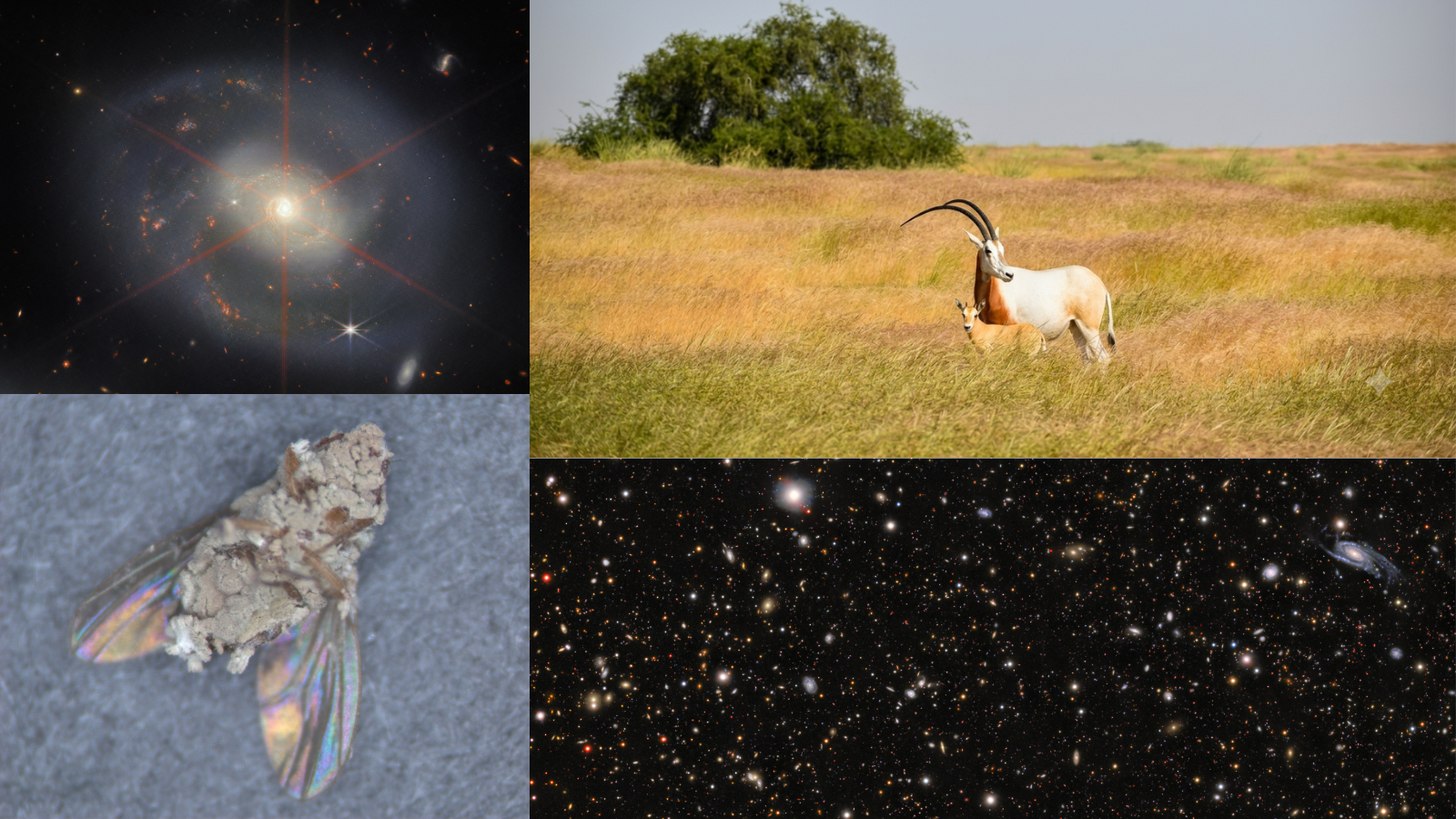
Once on the brink of extinction, the scimitar-horned oryx is making a comeback in Africa’s savannahs—and UMD scientists are waiting to see whether this new generation of animals still remembers its wild instincts.
Biology postdoctoral researcher Marron McConnell (Ph.D. ’26, biological sciences), who works with Distinguished University Professor of Biology Bill Fagan to study movement ecology, partnered with the Smithsonian’s National Zoo and Conservation Biology Institute to assess the reintroduced oryx population in multiple ways.
“This is one of the very, very rare cases for a large mammal to be brought back from extinction in the wild,” McConnell noted. “Reintroducing these animals from captivity is extremely complex and difficult. Only a few other comparable examples come to mind, such as the Arabian oryx and Przewalski’s horse.”
Rare Supernova Observation Reveals New Ways That Stars Can Die
A rare cosmic explosion gave UMD astronomers an unprecedented view of a massive star in its final moments, revealing a previously missing link between ordinary supernovae and the most energetic explosions in the universe.
A research team led by Jillian Rastinejad, a NASA Hubble Fellowship Program Einstein Fellow at UMD’s Department of Astronomy, observed the event and monitored its evolving light profile. They identified the initial burst of X-rays as a “shock breakout”—the moment when the powerful shock wave from a stellar explosion bursts through the star’s surface and releases the first light of a supernova. These phenomena last mere seconds to hours and are exceptionally rare to observe, with only one other shock breakout confidently identified in the past two decades.
The Broader a Fungus’s Diet, the Better It Kills Insects and Helps Plants
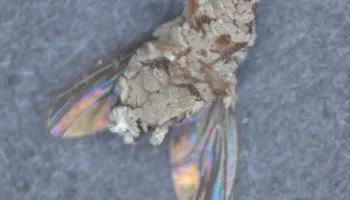
UMD entomologists have discovered that a single underlying trait—metabolic breadth, or the range of nutrients a fungus can use—links its ability to kill insects, partner with plants and thrive in different ecological roles. Rather than trading one lifestyle for another, some fungi become better at all of them.
The paper, "Metabolic breadth links insect pathogenicity and plant association in Metarhizium robertsii," by entomology postdoctoral associate Huiyu Sheng (Ph.D. ’24, entomology) and Distinguished University Professor of Entomology Raymond St. Leger, was published in the Proceedings of the National Academy of Sciences in July 2026.
Levi Burner Earns Intelligence Community Fellowship
Computer science postdoc Levi Burner (M.S. ’23, Ph.D. ’25, electrical engineering) was selected for the highly competitive Intelligence Community Postdoctoral Research Fellowship. Burner and Computer Science Assistant Professor Christopher Metzler are collaborating with a researcher from the U.S. intelligence community to develop new approaches for predicting atmospheric turbulence using advanced imaging systems and AI.
Atmospheric turbulence—the rapidly changing fluctuations in air that distort the path of light—poses a major challenge for long-range imaging and laser-based communication systems.
“Much of my research has focused on helping machines build meaningful representations of the world through observation and interaction,” Burner said. “This project applies those ideas to an environment that is constantly changing. We're asking whether AI can learn the underlying structure of turbulence well enough to predict it and improve how imaging systems perceive the world.”