
Across Maryland and the Mid-Atlantic United States, fall is rapidly approaching. But as the weather chills and pumpkins appear on porches, yard-owning Americans have a big choice to make: should they remove fallen leaves or let them rest? Every year, trees in urban America drop an estimated 37 million tons of leaves (Nowak & Greenfield, 2018). When homeowners elect to remove their fallen leaves, what happens to the spiders, caterpillars, beetles, and other insects that rely on decaying leaves for food and shelter? While it had been determined that removing leaves was bad news for soil-dwelling arthropods (Ober and DeGroote, 2014), inspiring campaigns to “Leave the Leaves” (AP News, Xerces Society), no one had yet tested this for aboveground insects and spiders.
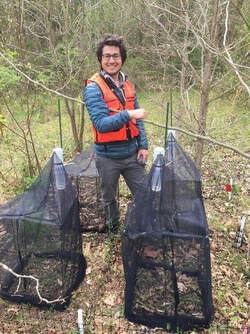
Dr. Max Ferlauto (Fig. 1), the state entomologist of Maryland and recent graduate of the University of Maryland’s Department of Entomology, was up for the challenge. Over two years, he experimented with the fallen leaves of 20 pesticide-free suburban Maryland yards to work out the hidden effects of leaf removal on insects and the ecosystem. He set up experimental and control square meters across the lawns. In the experimental squares in ‘high maintenance’ spaces, areas of yards that were regularly raked, he added leaves. In the ‘low maintenance’ experimental squares, located in areas of the yard where leaves were historically left to rest, he removed the leaves. In the spring, he set up traps that captured insects emerging from these squares, which allowed him to sample the tens of thousands of pollinators, predators, herbivores, and decomposers that dwell in yards.
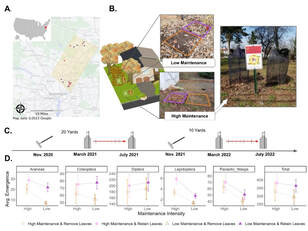
The consequences of removing leaves were unmistakable for some yard inhabitants. In both low and high maintenance areas, squares without leaves had far fewer emerging moths and butterflies (Fig. 2). The same was true for spiders in low maintenance squares (Fig. 2). The abundance of other groups, such as flies and parasitoid wasps were not significantly affected (Fig. 2). Leaf removal did not just affect the number of insects present, but also which kinds of insects could be collected. As moth and butterfly populations fell, so did the types of parasitoid wasps that fed on them (Ferlauto and Burghardt, Preprint). Dr. Ferlauto had found that removing leaves could ripple up the food chain in one season. But did removing leaves also negatively affect the yard ecosystem?
Dr. Ferlauto tracked carbon, the building block of life, and decomposition in the soil of these test lawns. Ecologists consider soil carbon and decomposition rates to be important measures of soil health that can affect the health of the ecosystem (Berryman et al., 2020). Using soil cores, he found that when leaves had been consistently removed for many years, yards suffered twin losses in their soil carbon and decomposition rates that could not be reversed by letting leaves rest two years in a row (Ferlauto et. al., 2024). When key ecosystem processes cannot quickly rebound, it becomes much more important to understand what we can do to halt or begin reversing these losses. Dr. Ferlauto took a step back from suburban yards and a step into an experimental forest to do just that.
Just south of the state capital of Annapolis, the Smithsonian Environmental Research Center maintains a forest that helped Dr. Ferlauto to answer two questions: 1) could a diversity of planted trees rescue raked plots from losses in insect populations? 2) could different leaf management strategies like shredding or piling serve as viable alternatives to complete leaf removal? He found that diverse tree communities could not prevent losses to insect communities. He found that shredding and removing leaves had similar negative effects on insect communities. He found that piling and retaining leaves had similar positive effects on insect communities. While this work was conducted in an experimental forest and not a suburban yard, Dr. Ferlauto believes that his findings could benefit homeowners looking to preserve their insect communities.
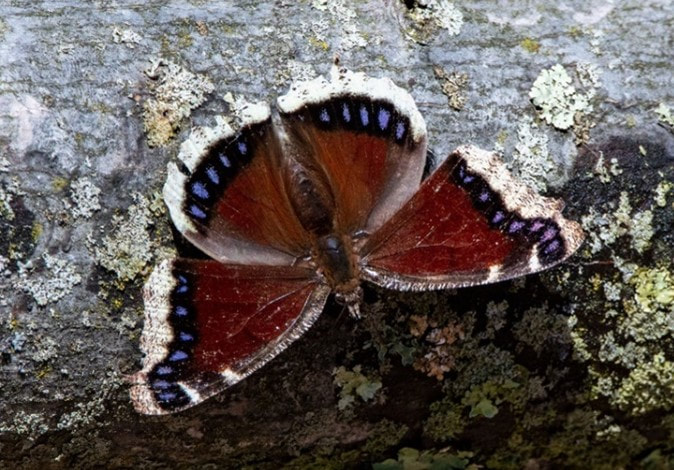
In this era of global change, homeowners have a responsibility but also a great opportunity to preserve the many-legged creatures that call their little pockets of nature home. Dr. Ferlauto has laid the groundwork by establishing that leaf removal can lead to immediate losses of insect abundance and community composition as well as lasting damage to the soil health. He demonstrated that a single homeowner can make a difference in the health of their home ecosystem, that these choices can have lasting effects, and even determined how to best preserve biodiversity through keeping and piling leaves (Fig. 4). Now, homeowners can take agency over their yard management with a better understanding of the impacts of their choices, and hopefully, work to preserve their slice of the natural world.

Read more about Dr. Ferlauto’s work in these publications:
- https://today.umd.edu/stop-raking-leaves-this-spring-and-keep-the-carbon-in-your-soil
- https://cmns.umd.edu/news-events/news/max-ferlauto-karin-burghardt-how-preserve-beneficial-hibernating-insects-your-yard
- https://www.washingtonian.com/2023/11/06/why-you-shouldnt-rake-your-yard-according-to-this-umd-entomologist/
- https://dbknews.com/2021/10/28/prince-georges-county-environment-leaves-yards/
- https://inharmony.com/what-should-you-do-with-your-leaves/
- https://www.marylandnature.org/get-involved/events/event/suburban-leaf-litter-and-overwintering-insects/
Author
Ben Burgunder is a third-year master’s student in the Fritz Lab. He is interested in whether mosquito vector community composition and West Nile virus prevalence can help explain patterns of human West Nile virus cases in Chicago. He can be reached at bburgund@umd.edu.
Literature Cited:
1. Berryman, Erin, Jeffrey Hatten, Deborah S. Page-Dumroese, Katherine A. Heckman, David V. D’Amore, Jennifer Puttere, Michael SanClements, Stephanie J. Connolly, Charles H. (Hobie) Perry, and Grant M. Domke. “Soil Carbon.” In Forest and Rangeland Soils of the United States Under Changing Conditions: A Comprehensive Science Synthesis, edited by Richard V. Pouyat, Deborah S. Page-Dumroese, Toral Patel-Weynand, and Linda H. Geiser, 9–31. Cham: Springer International Publishing, 2020. https://doi.org/10.1007/978-3-030-45216-2_2.
2. Ferlauto, Max, Lauren Schmitt, and Karin Burghardt. “Legacy Effects of Long‐term Autumn Leaf Litter Removal Slow Decomposition Rates and Reduce Soil Carbon in Suburban Yards.” PLANTS, PEOPLE, PLANET 6, no. 4 (July 2024): 875–84. https://doi.org/10.1002/ppp3.10499.
3. Nowak, David J, and Eric J Greenfield. “US Urban Forest Statistics, Values, and Projections.” Journal of Forestry 116, no. 2 (March 12, 2018): 164–77. https://doi.org/10.1093/jofore/fvx004.
4. Ober, Holly K., and Lucas W. DeGroote. “Repeated Raking of Pine Plantations Alters Soil Arthropod Communities.” Forests 5, no. 4 (April 2014): 689–714. https://doi.org/10.3390/f5040689.
5. “There’s a Movement to ‘leave the Leaves’ in Gardens and Lawns. Should You Do It? | AP News.” Accessed October 14, 2024. https://apnews.com/article/leave-leaves-gardening-fall-cleanup-7e007754b7a579347bf6bedcfed4ba1e.
6. Xerces Society. “Leave the Leaves!” Accessed October 14, 2024. https://xerces.org/blog/leave-the-leaves.
Written by Ben Burgunder