
written by: Pablo Stilwell
According to the CDC 2026, mosquitoes are the world's deadliest animal, killing an estimated 700,000 people annually. However, mosquitoes themselves are not the direct cause of these deaths. Instead, these insects act as delivery systems for many viruses, protists, and nematodes which cause a myriad of diseases worldwide. This includes malaria-causing Plasmodium parasites, which results in over 280 million cases and kills over 600, 000 people each year globally (CDC 2026). Regardless of the mosquito species or the disease causing pathogen it carries, pathogen transmission only occurs through a bite once the mosquito has found us. It is this biting process that Dr. Joanna Konopka, a Neuroscience Research Associate at the Johns Hopkins University School of Medicine and Johns Hopkins Malaria Research Institute at the Bloomberg School of Public Health, is investigating in detail to stop it by understanding how mosquitoes interact with human skin.
Dr. Konopka pointed out, “During a typical bite, a female mosquito can stealthily drink up to five microliters of blood from a given host. She takes this seemingly insignificant amount of blood and uses the protein to develop her own eggs.” Though harmless this whole process may seem, it is the reason behind so much human pain and suffering.
During the UMD, Department of Entomology seminar, Dr. Konopka walked through the basics of how mosquitoes locate a suitable host to feed on. A combination of chemical, heat, visual, and tactile cues are used. To facilitate this, mosquitoes have evolved many specialized adaptations to organs such as their antennae, mouthparts, and even legs. However, mosquitoes are a diverse group and changes in interspecific feeding patterns necessitate tracking the precise mechanisms employed by individual species. Importantly, understanding direct-contact interactions remains critical, as female mosquitoes are still able to locate and feed on humans despite the widespread use of traps, repellents, and insecticides.
Understanding these different host-contact behaviors allows for the development of strategies to prevent malaria and other deadly pathogen transmission by preventing contact with the host altogether. Using genetic mapping, neural imaging, and high-speed videography, Dr. Konopka investigates the direct contact sensory interactions between Anopheles mosquitoes specifically and their human hosts.
So how do mosquitoes detect and process chemical cues? Dr. Konopa explained that mosquito appendages are lined with microscopic sensory structures known as sensilla that allow them to detect environmental cues. Inside these structures are sensory nerve cells equipped with distinct receptor proteins tuned to particular chemicals. When an appropriate compound is encountered, it activates the receptor and triggers an electrical signal that is relayed to the mosquito’s nervous system. CRISPR-based genetic labeling and fluorescence labelling allow for the mapping and visualization of mosquito sensory neurons (Figure 1). This reveals the distribution and density of specific neurons throughout the different appendages.
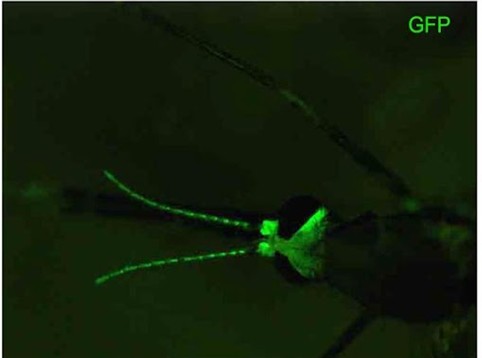
What does a mosquito actually do when it bites you? There are two main types of interactions, the above skin interactions that we can see, and the interactions occurring under the skin. Both are important, but recording the behaviors of both turns out to be a bit of a challenge. Dr. Konopka was able to capture surface activities with high-speed videography where she tracked body parts involved in biting using deep learning. To capture below skin activities, she recorded electronic signals using electropenetrography, where a human host holds an electrode, and allows a wired mosquito to bite them which completes the circuit. Using this approach, she was able to observe five distinct phases of the bite under the skin, which are skin piercing, blood vessel searching, blood ingestion, mouthpart retraction and mouthpart withdrawal.
Mosquito biting is a highly coordinated, multi-phase behavior involving many dynamic movements. Sensory neuron mapping revealed that neurons are unevenly distributed across appendages and serve roles in different structures. Legs were found to be the first point of contact made with human skin. Once in place, mosquito legs actually play an active role in detecting chemical cues such as avoiding repellent.
Mosquito-borne diseases remain one of the greatest global health challenges due to their ability to find and blood-feed on human hosts. Dr. Konopka’s work lays a foundation of the precise mosquito host detection and biting mechanisms. Her findings can guide future research on advancing critical preventative measures at the last line of defense, once mosquitoes are our skin.
References:
Centers for Disease Control and Prevention. (2026, February 20). Fighting the world’s deadliest animal. U.S. Department of Health and Human Services. CDC
Konopka, J. K., Task, D., Poinapen, D., & Potter, C. J. (2023). Neurogenetic identification of mosquito sensory neurons. iScience, 26(5), 106690. https://doi.org/10.1016/j.isci.2023.106690