
written by: Eileen Brandon
Julie Lesnik, an anthropologist and associate professor at Wayne University, is a proud advocate for indigenous people and consuming arthropods as a sustainable food source. She presented her research from her book “Edible Insects and Human Evolution”1 to the University of Maryland Entomology Department, where she described the complex history of insect consumption in the United States and the ways culture has influenced our trajectory to a world that is in dire need of sustainable solutions.
Maya the chimp probes a large mound of dirt at the heart of a forest in The Republic of The Congo. She uses a stick to fish small creatures out of the holes in the mound. Termites, particularly the genus Macrotermes, are renowned for their high protein content in the insect consuming world.4 The tools the chimp uses are simple, and resemble other tools anthropologists have uncovered at archeological sites around human civilizations in Tanzania.2 Simple bone fragments could easily disregarded as waste from a hunt, but when observed closely one can see wear patterns on the tips from repeated use. When researchers investigated the cause of these patterns, they found they were reminiscent of patterns caused by digging in hardened substrate, like that which covered the large termite mounds found nearby.2,3
This is not the only anthropological evidence that supports people eating insects. In fact, much of the evidence of humans eating bugs is not ancient, but modern.
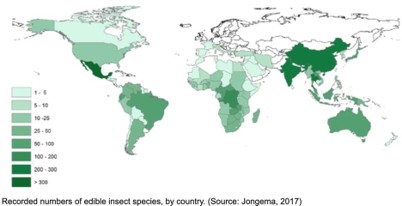
If you observe a world map published by Yde Jongema in 2017, you can see there are many places where insects are consumed around the world. Lesnik wanted to investigate the reasons why some societies consume insects more than others.6 She proposed three possibilities: Latitudinal position, implementation of agriculture (this may have caused humans to view insects as pests rather than food), and gross domestic product (wealth). She found correlations for both Latitudinal position and GDP. However, these associations changed when she eliminated North America and parts of Europe, places commonly referred to as ‘The global West’. When these countries were removed, the GDP association was lost completely, revealing that cultural factors, not wealth, are what determine whether different countries eat insects. It is known to most of the people reading this that eating insects is uncommon in the United States. So why is eating insects OK for most of the world but not here?
Lesnik explains that European colonization was largely to blame for why we don’t eat insects in the United States. During colonization the concept of a racial hierarchy was essential for maintaining a harsh and unequal economic and governing system. Native people who had been eating insects for thousands of years were taught by Europeans their way of life offended god and the Natural order. Christian teachings of subservience and obedience were forced onto Indigenous Americans and people of other colonized nations. Christianity also influenced the Western World in other ways that make it oppose insects more directly. The bible teaches that the way we live our lives can make us either ‘pure’ or ‘unclean.’ This concept of what we eat having the ability to make us unclean might have played a part in Europe’s rejection of arthropod consumption, as arthropods were also considered the lowest organism in the natural order and close to hell and the devil, Gods nemesis. The idea of the racial hierarchy and the perception of uncleanliness toward insect eating continues to impact science as well as our diets to this day.
“it was like the bursting of a boil, so full of great white maggots was it." Reeling with disgust, Rasmussen asked how they could possibly eat maggot-infested meat. “You yourself like caribou meat, and what are these maggots but live caribou meat?” they responded. “They taste just the same as the meat and are refreshing to the mouth.”
-a report from the Fifth Thule expedition, The Danish Expedition of Arctic North America from Knud Rasmussen in 19216
The idea that neanderthals ate maggots was not something scientists had considered until recently, says Lesnik. It was commonly believed that neanderthals, one of humanity’s closest cousins, were “hyper carnivores”, obtaining most of their energy by eating large game animals like mammoths. These perceptions were fueled by analyses of nitrogen isotopes present in the preserved remains of these hominins. However, the idea that Neanderthals only ate meat is flawed, as their digestive systems were likely similar to ours, and homo sapiens cannot survive off a hyper carnivore diet. When supplied with only protein as an energy source, ‘Rabbit starvation’ occurs. Human metabolisms can only extract around 300 calories in energy a day from protein – much less the amount we need to survive. Lesnik explains that the isotope numbers seen in neanderthal remains could be explained by consuming maggots, which have high nitrogen content. Lesnik and colleagues observed isotope numbers from fly larva of different species and found they had high Nitrogen content that could accumulate in the organisms that consumed them.7 Lesnik highlighted that the original conclusion that Neanderthals were hyper carnivores, reveals a tendency to “other” groups we perceive as different from ourselves. When we acknowledge that neanderthals are a type of human, not some distant “other” group, we realize they could not have survived as hyper carnivores. Interestingly, the misconception of the carnivore diet in Neanderthals has likely contributed to the rampant misinformation surrounding the modern human diet. You may have heard about the viral “Lion diet” on social media and even seen the recently published food pyramid from the Trump administration. Here, they’ve placed red meat at the top of the pyramid and bread and grains at the bottom, not to mention there is not a single arthropod in sight.
Resources
1 Lesnik, Julie J. Edible insects and human evolution. University Press of Florida, 2019.
2 Raphaël Hanon, Francesco d'Errico, Lucinda Backwell, Sandrine Prat, Stéphane Péan, Marylène Patou-Mathis, New evidence of bone tool use by Early Pleistocene hominins from Cooper’s D, Bloubank Valley, South Africa, Journal of Archaeological Science: Reports, Volume 39, 2021, 103129, ISSN 2352-409X, https://doi.org/10.1016/j.jasrep.2021.103129. (https://www.sciencedirect.com/science/article/pii/S2352409X21003412)
3 Lesnik, Julie J. "Bone Tool Texture Analysis and the Role of Termites in the Diet of South African Hominids." PaleoAnthropology 2011 (2011): 268-281.Department of
Anthropology, Northeastern Illinois University, 5500 N. St. Louis Avenue, Chicago, IL 60625, USA; julie.lesnik@gmail.com, 2011 PaleoAnthropology Society.
4 Julie J. Lesnik, Termites in the hominin diet: A meta-analysis of termite genera, species and castes as a dietary supplement for South African robust australopithecines, Journal of Human Evolution, Volume 71, 2014, Pages 94-104, ISSN 0047-2484, https://doi.org/10.1016/j.jhevol.2013.07.015. (https://www.sciencedirect.com/science/article/pii/S0047248413002479)
5 Lesnik, Julie J. "4 The Strangeness of Not Eating Insects." Evaluating Evidence in Biological Anthropology: The Strange and the Familiar 83 (2020): 71.
6 Thule Expedition. Report of the Fifth Thule Expedition, 1921-24: the Danish Expedition to Arctic North America. Copenhagen: Gyldendalske Boghandel, Nordisk Forlag, 192752.
7 Melanie M. Beasley et al. Neanderthals, hypercarnivores, and maggots: Insights from stable nitrogen isotopes.Sci. Adv.11,eadt7466(2025).DOI:10.1126/sciadv.adt7466
8https://cdn.realfood.gov/DGA.pdf
11Jongema, Yde. "List of edible insects of the world." (2017). Insects as food - an option for sustainable food production?
![[Seminar Blog] You smell like you might eat me! How ladybeetle stink can fix your aphid problems](/sites/default/files/styles/16_9_350x200/public/articles/seminar-blog_herman_fall-26_pic-1.jpg.webp?itok=aoelPIM6)
![[Seminar Blog] The Present and Future of Bt GMOs, RNAi pesticides, and the Development of Resistance](/sites/default/files/styles/16_9_350x200/public/articles/entomology_fall26seminarblog_jarat_1.png.webp?itok=C4gCYLC7)
![[Seminar Blog] From Sweat to Supper: The Sensory Science Behind Mosquito Host Detection](/sites/default/files/styles/16_9_350x200/public/articles/seminar-blog_raji_fall25_pic-1.jpg.webp?itok=sE7-bgrW)