
Written by: Lillian Davis
Although the green body form of Master Mantis from Kung Fu Panda may be the most famous mantis in popular media, the insect order Mantodea contains over 2400 species. Researcher, Dr. Christopher Oufiero, in the Department of Biological Sciences at Towson University, is fascinated by the unique body form and movement of Manties. His most recent research has striven to answer questions related to how mantises attack, capture prey, and ingest their food.
Attack
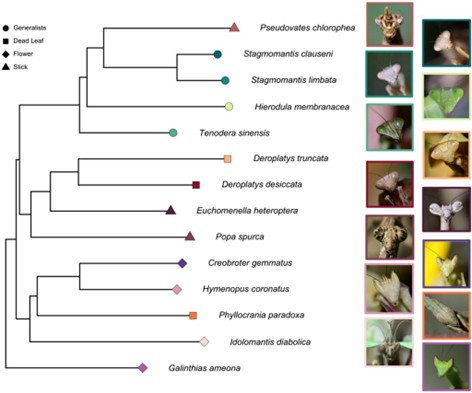
Mantises vary in coloration and body form (Fig.1, Oufiero et al. 2026). This group of insects are primarily ambush predators. They remain motionless in trees or shrubbery, where they blend in with the surrounding leaves, sticks, and bark before using their modified forelimbs to strike rapidly at nearby prey. Instead of relying on venom or strangulation to subdue their prey they hold tight and eat the animal alive. In order to reach out and snatch the prey they have developed great stereopsis or depth perception.
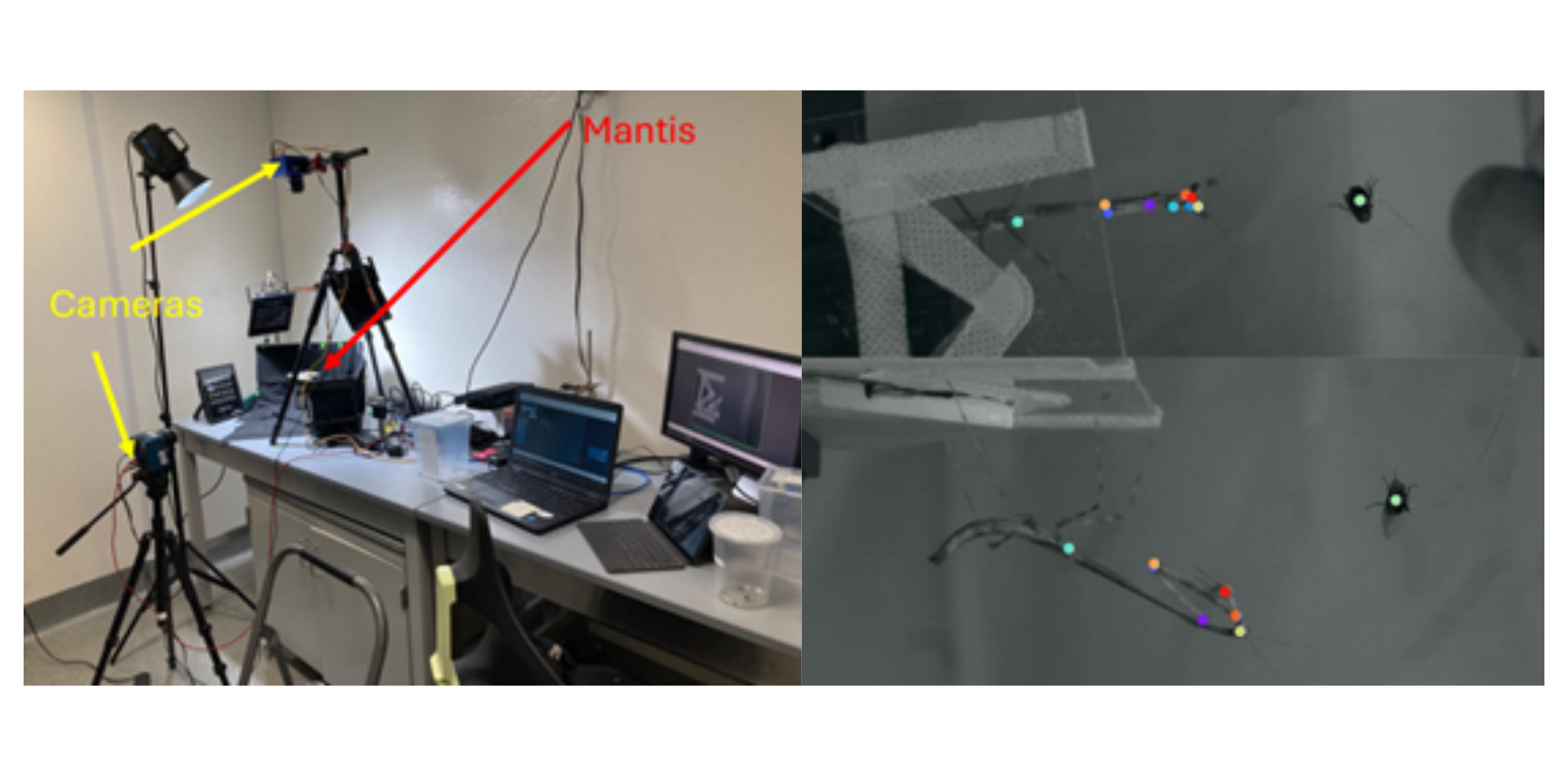
Within predators successful prey capture varies greatly. In lions, studies have shown that their success can vary between 21.8% to 89.9% depending on a number of variables (Stander & Albon 1991) including terrain, weather, and hunting party. Dr. Oufiero’s lab is using high speed cameras and machine learning to track the body movements of Mantsis during prey capture (Fig. 2). Using this technology in their 2024 study they analyzed the range of motion of praying mantis and found that the success of the capture depends a lot on how far the prey item is (Oufiero et al. 2024). In the species studied they found that the praying mantis was the most successful when the prey item was about 3.2cm away although the mantis would attempt to capture the prey when the item was anywhere from ~1 to ~7cm away. Although that seems small to us it is impressive what the mantis is capable of grabbing.
Prey Capture and Ingestion
Praying Mantsis have been recorded to consume prey much larger than themselves including small birds (Nyffeler et al 2017). That is a lot of food. With the understanding that the longer a praying mantsis is busy processing their food the less time they are actively hunting Dr. Oufiero began a new study. In this case he was measuring how long different species of mantsis held their food and how long it took them to finish eating (to see one of the recordings from the study visit: https://onlinelibrary.wiley.com/doi/10.1002/ece3.73091). They found that among the 14 species included in this study those with larger body masses consumed their food faster and with a lower handling time. However although the larger mantsis ate their food faster their metabolic rate was not scaling at the same rate. As the metabolic rate determines how fast the energy from the food can be allocated within the body that means although the large mantis are eating faster they are not as efficiently digesting that food (Oufiero et al. 2026). This provides fascinating insight into the trade-offs between different body forms and sizes across Mantises.
To learn more about Dr Oufiero’s current research and see some awesome videos of Mantises visit his website at https://wp.towson.edu/coufiero/ .
About the authors: Lillian Davis is a first year PhD student in the Department of Entomology. She is being co-advised by Dr Evan Economo and Dr Karin Burghart. She is currently researching insect diversity using metabarcoding tools.
Oufiero, Christopher E., Lohitashwa Garikipati, Elizabeth McMillan, Mary Katherine Sullivan, and Ryan Turnbaugh. “Modulation of Prey Capture Kinematics in Relation to Prey Distance Helps Predict Success.” Journal of Experimental Biology 227, no. 11 (2024): jeb247311. https://doi.org/10.1242/jeb.247311.
Stander, P. E., and S. D. Albon. “Hunting Success of Lions in a Semi-Arid Environment.” In Mammals as Predators: The Proceedings of a Symposium Held by The Zoological Society of London and The Mammal Society: London, 22nd and 23rd November 1991, edited by N. Dunstone and M. L. Gorman. Oxford University Press, 1993. https://doi.org/10.1093/oso/9780198540670.003.0007.
Nyffeler, Martin, Michael R. Maxwell, and J. V. Remsen. “Bird Predation by Praying Mantises: A Global Perspective.” Wilson Journal of Ornithology (Waco) 129, no. 2 (2017): 331–44. https://doi.org/10.1676/16-100.1.
Oufiero, Christopher, Marlena Wood, and Elizabeth McMillan. “Allometry of Ingestion Among Habitat Mimicking Praying Mantises.” Ecology and Evolution 16, no. 2 (2026): e73091. https://doi.org/10.1002/ece3.73091.