
written by: Logan Lott
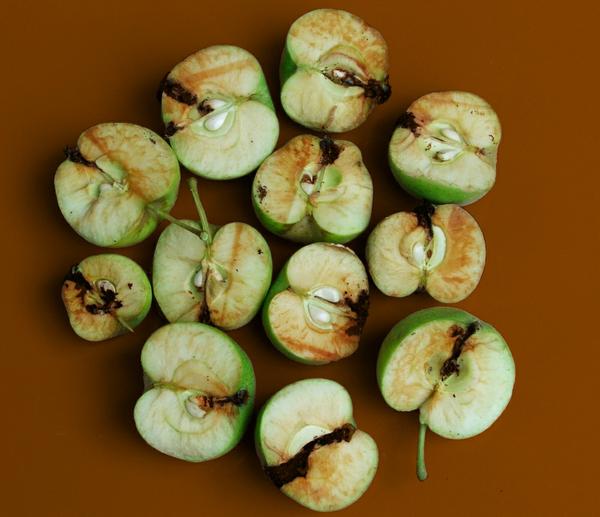
When we think of an orchard, we often picture gorgeous apples and pears hanging heavily from their branches, just waiting to be picked. It’s easy to imagine reaching up, plucking a ripe fruit, and taking a crisp, juicy bite. However, that perfect moment quickly dissolves at the unsettling squirm of a moth larva hidden inside. What feels like a brief horror to the person biting is an even greater nightmare for the orchard farmer, whose livelihood depends entirely on a pest-free, marketable harvest. Even one live larva found in a single fruit means throwing out the whole barrel of produce. It is vital for farmers to find tactical, proven methods to manage orchard pests.
On the East Coast, orchard farmers contend with several common pests, including codling moths (Cydia pomonella) and oriental fruit moths (Grapholita molesta). Both lepidopteran species depend on locating suitable fruit to complete their life cycles. Females lay eggs on the fruit or on nearby leaves, and once hatched, the larvae burrow inside the fruit and feed. Larvae will exit the fruit for pupation, leaving behind brown tunnels of frass that mark their exit path. Codling moths typically produce about 3 or 4 generations per year, whereas oriental fruit moths may produce up to 5, increasing the risk of rapid population growth and outbreaks due to their high reproductive potential. Orchards provide an ideal habitat, as closely planted fruit trees offer abundant resources to lay eggs and increase opportunities for mating due to high concentrations of adult moths.
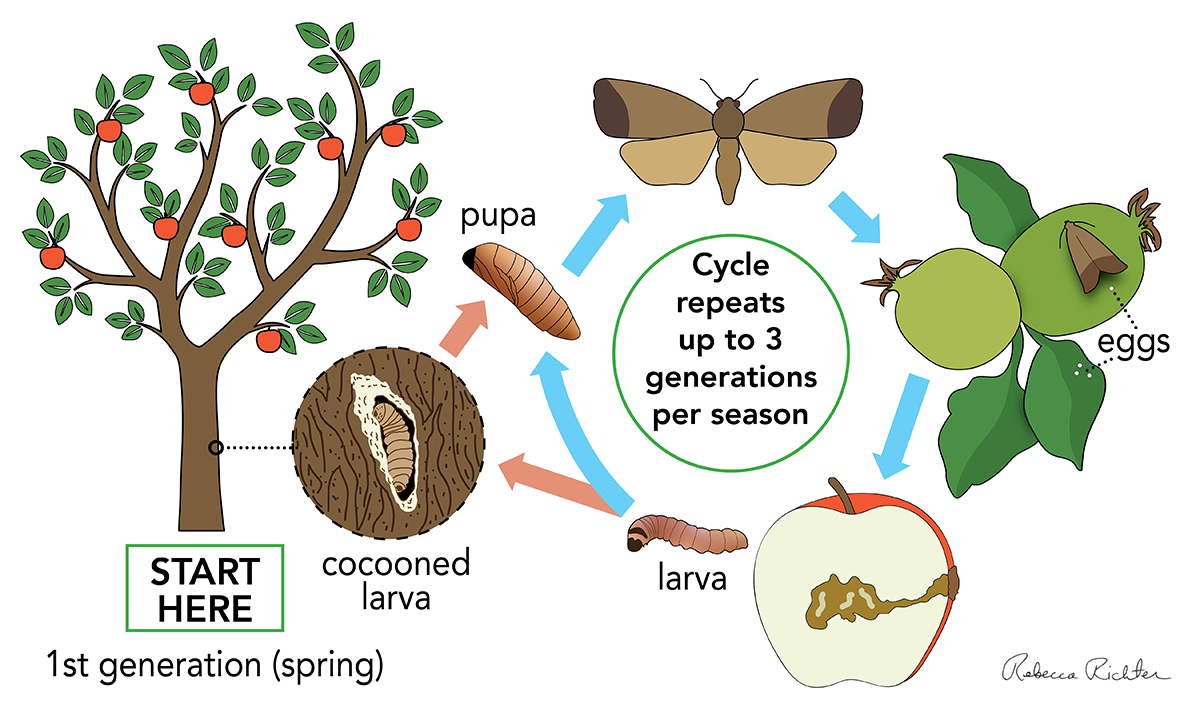
In order for these moths to locate their potential mates, the female produces a species-specific plume of her pheromone. Male moths use their antennae to smell for this aroma and are lured to the female. One way to reduce the number of moths in an orchard is to inhibit their ability to find suitable mates, thus impacting their ability to reproduce. Scientists have been successful at synthetically reproducing the moths’ sex pheromones. This synthetically produced pheromone has been effective at preventing the mating of both species of moths, the codling moth and oriental fruit moth. These synthetic pheromones are then fumigated through the orchard, causing confusion for any male codling or oriental fruit moth looking for love.
Dr. Laura Nixon is a chemical ecologist who has spent her career investigating the role that organisms, such as lepidopteran pests, interact with their environment through chemical compounds (such as pheromones). As a post-doctoral researcher, Dr. Nixon sought to understand the role that mating disruption could have on orchards in the Eastern United States. Specifically, she wanted to determine methods that could be taken to control for these lepidopteran pests that did not rely entirely solely on insecticidal applications, and instead incorporated more physiological species-specific disruptions. Likewise, she sought to understand how to follow proper guidelines for disbursing synthetic pheromones, as most of the literature on this subject was written for locations with different topography and farm styles than the farms in the Appalachian region.
Throughout the growing seasons in 2023 and 2024, Dr. Nixon worked to integrate threshold-based sprays with mating disruption and understand the role that both of these methods have on reducing fruit injury. This involved setting up pheromone-baited trapping stations throughout the orchard, where a specific number of moths caught triggered insecticidal application. This experiment was conducted on an orchard, with four separate areas of the orchard receiving a different method of monitoring and treatment. These areas of the orchard included a control group (grower standard insecticide sprays), mating disruption only, mating disruption and the standard recommendations for thresholds, and mating disruption with a reduced threshold where less moths would prompt spraying insecticide.
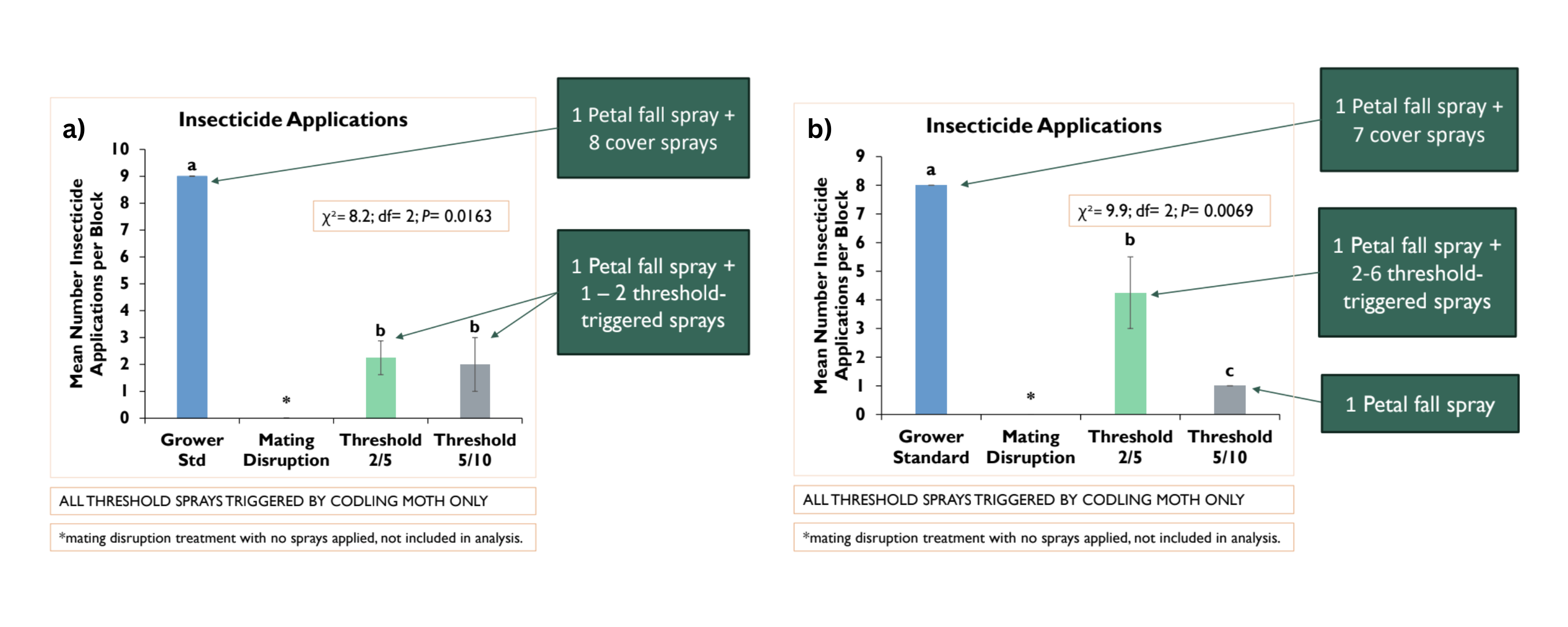
While mating disruption alone did not effectively decrease moth injury, in conjunction with threshold spraying, it was as effective as the standard spraying of insecticides while reducing the number of sprays needed. Likewise, mating disruption and threshold sprays reduced standard insecticidal applications more than 50%. This study concluded that mating disruption can work in non-compliant apple orchard blocks, even if the topography and orchard blocks are different from those mentioned in previous studies on this topic. Threshold-based sprays, which focus on only spraying pesticide when insect populations exceed the determined threshold, allow for “problem blocks” of the orchard to be treated as needed. This allows growers to have targeted insecticidal treatment, versus spraying “problem blocks” alongside other areas that may not need to be treated as often. This can be a positive change to help promote the population of beneficial insects in the orchards, such as pollinators, by having less general insecticide in the environment. This is also beneficial to the producers, as this means they will have to purchase and apply less pesticides overall.
Dr. Nixon earned her PhD from Lincoln University near Christchurch, New Zealand, before moving to the United States’ East Coast for two post-doctorate positions, one at USDA-ARS Appalachian Fruit Research Station and another at Rutgers University’s Agricultural Research and Extension Center. Her passion for helping growers has led her to her current role as the Extension Agent for Ornamental Integrated Pest Management and Entomology at the Central Maryland Research and Education Center Clarksville Facility (CMREC). Outside of lepidopteran pests, she also has experience working with the brown marmorated stink bug, spotted lantern fly, and plum curculio, all of which can cause damage to orchards and other agricultural systems. In her new role, she will continue sharing the latest findings on insect pest management while promoting her passion for chemical ecology to growers and the broader community.
About the Author:
Logan Lott is a first-year master’s student in the Department of Entomology in the Megan Fritz Lab and A-SWEL Lab. She is currently working on how tick ecology, habitat characteristics, and human behavior interact to shape the spread of tick-borne diseases in Maryland.