
written by: Makala Harrison
From crop fields to the lawn of the U.S. Capitol, Dr. Emily Mueller has seen how insects quietly shape some of the largest environmental challenges, and how extension communicates practical solutions to farmers and land managers. In a recent colloquium talk for the University of Maryland Department of Entomology, Dr. Mueller – a plant health care specialist with the Architect of the Capitol – offered a behind-the-scenes look at how entomology directly supports agriculture, communities, and public spaces.
Dr. Mueller began her career in entomology researching how insects spread plant diseases. Many of today’s most damaging crop losses are caused not only by insects feeding on plants, but by insects that transmit viruses and other diseases between plants. Beyond general crop loss, insect herbivory and disease transmission even affects the aesthetic quality of food, causing negative impacts on the system of food production. During Dr. Mueller’s research at the University of Wisconsin-Madison, she used various techniques including aphid trapping, virus testing, plant surveys, and vector capability surveys to determine that a species of invasive aphids were not only consuming crops, but spreading viruses between them. However, research alone is not enough to address the issues caused by pest insects, those involved in the growing of crops need to be given the correct advice that will help them in their work, this is the role of extension services. Extension is the process of connecting and applying research to real people and places, and it looks different depending on the goals and location. In the United States, extension systems are closely tied to universities, specifically land-grant institutions. Researchers, extension specialists, and farmers work together, allowing new discoveries to move from the lab into everyday agricultural practice. Dr. Mueller emphasized that this connection makes it easier to test new ideas, share results, and provide support for growers.
At the local level, extension work includes on-farm variety testing, integrated pest management, and training in farm safety. Rather than promoting a single solution, extension specialists help farmers compare crop varieties, monitor pests, and make management decisions based on the actual condition of their fields. Extension also helps communities internationally. However, extension networks in other counties are not always as tightly connected to research institutions. This disconnect can make it more difficult for farmers to access new technologies, disease management strategies, and improved crop varieties.
International extension often focuses on building systems and partnerships rather than simply delivering information. Dr. Mueller discussed her experiences working in Africa through the Consortium of International Agricultural Research Centres and the International Potato Center, where she focused on creating profitable seed systems for orange-fleshed sweet potatoes. Unlike the native white-fleshed variety, which is less nutrient-dense, particularly lacking in vitamin A, the orange-fleshed sweet potato is a vital source of nutrients. This is especially important for communities grappling with malnutrition. The program supported local farmers with technical training in crop management, helped to strengthen markers, and worked to ensure that the planting material was adapted to local climates. Extension at this scale also played a social role, supporting women’s participation in agriculture and improving food security at the community level. Since sweet potatoes are primarily grown and sold by women in many of the communities Dr. Mueller worked with, extension efforts connected with local women to teach about the benefits of new sweet potato varieties and growing techniques.
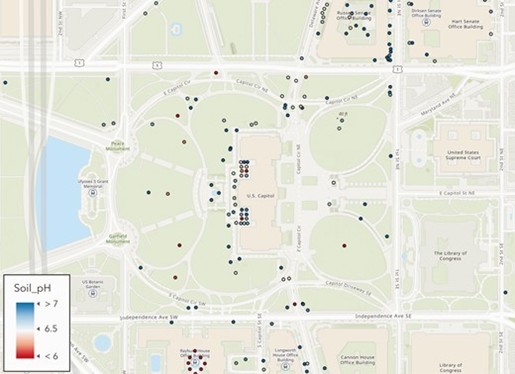
Dr. Mueller ended by discussing extension on the federal level and her work in applied plant health. While the federal setting is very different from farms and international development programs, the goal is still the same: translating scientific knowledge into practical management. The grounds of the U.S. Capitol includes dozens of historically significant trees and a variety of green spaces. Protecting the historic plants and visual aesthetics of the grounds requires a balance of public safety and environmental responsibility, with stakeholders ranging from the Senators working on Capitol Hill to the millions of guests that visit each year. At the federal level, extension takes the form of training staff, developing decision guidelines, and creating systems that support long-term management. Field staff use a cell phone based program to record pest observations, plant health issues, and pesticide inputs, all linked to specific locations. This geo-reference record keeping – integrated into the workflow by Dr. Mueller – allows managers to track patterns over time and make evidence-based decisions about when and where action is needed (Fig. 1). The information gathered by the program is also used when proposing management ideas to the Senators and other federal officials at the Capitol, who have a role in approving management decisions.
Across local farms, international development programs, and federal landscapes, extension is the critical link between research and impact. It ensures that scientific discoveries do not remain only in academic journals, but become tools to improve food production, protect historic landscapes, and promote more sustainable land management. Dr. Mueller’s talk highlighted that entomology goes beyond studying insects in a lab; from helping farmers manage crop damage, supporting international nutrition programs, and protecting the trees that shape one of the nation’s most recognizable public spaces, entomologists play a vital role in solving real-world problems.
Citations:
Emily Mueller, Michael Naas, Katie Serock, Melissa Westbrook, James Kaufmann, The U.S. Capitol Grounds and Arboretum: an iconic landscape with a holistic approach to pest management, Journal of Integrated Pest Management, Volume 15, Issue 1, 2024, 31, https://doi.org/10.1093/jipm/pmae023.
Learn more:
U.S. Capitol Grounds
https://www.aoc.gov/explore-capitol-campus/buildings-grounds/capitol-grounds Extension at UMD
https://extension.umd.edu/home/
Makala Harrison is a Master’s student in the Shultz lab and studies Opiliones (harvestmen) in eastern North America.