
written by: Michael Adu-Brew
Not every researcher or scientist follows a straightforward path to find their career. Some start in one field and gradually shift their focus to another because they are curious. Dr. Benjamin White, Chief of the Section of Neural Function at the National Institutes of Health began his journey with an interest in mathematics and physics. He had an initial desire to pursue theoretical physics, but during his undergrad, found his personal strengths did not align with the intense level of mathematics required. Like many students searching for a meaningful path, he considered becoming a medical doctor but then, after taking a biology course, one area stood out to him - the nervous system. That realization caused a shift in direction, eventually leading Dr. White to complete a PhD in neural sciences. Along this path, one apparently simple biological process became a powerful window into understanding how behavior is controlled: ecdysis in the fruit fly, Drosophila melanogaster.
Ecdysis
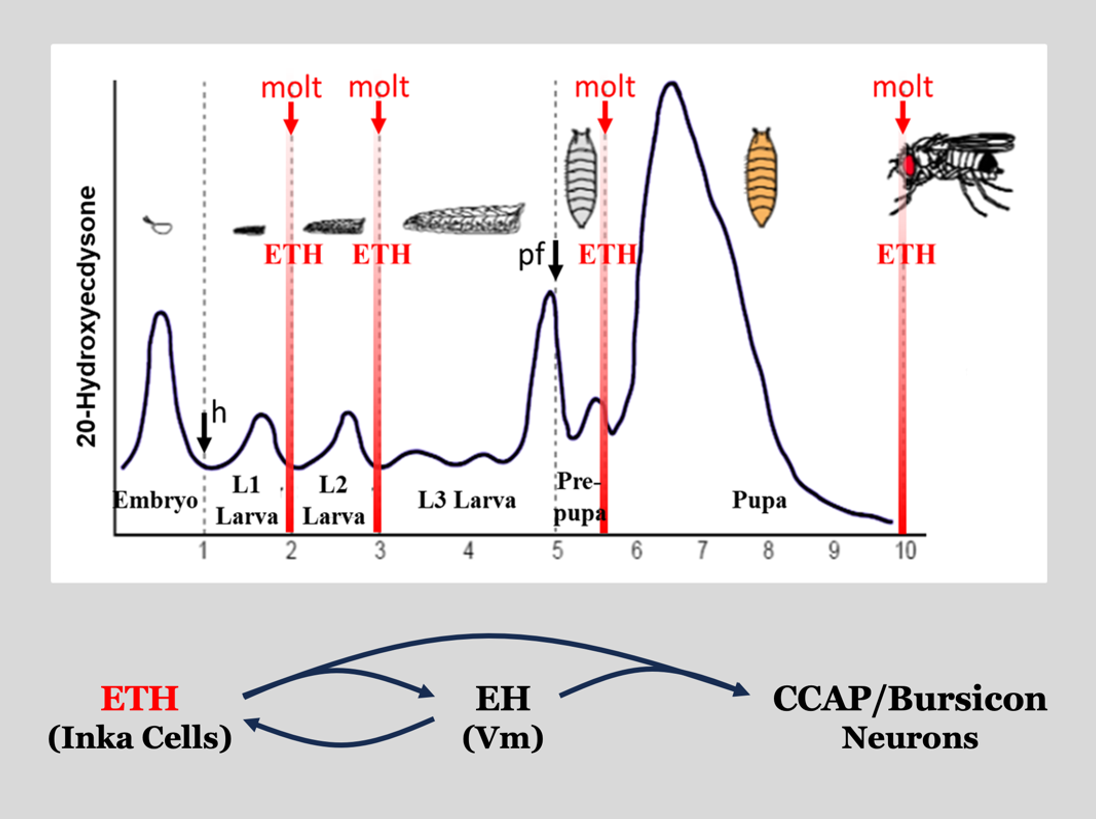
Unlike humans, insects don’t have an internal skeleton, instead they wear theirs on the outside of their body like a coat of armor. However, as they grow, they need to shed this armor to accommodate their increase in size. This shedding or molting process is called ecdysis and it is not just a physical event but is rather a precisely timed sequence of behaviors, orchestrated by hormones and neural circuits working together with extraordinary coordination. At the center of this process is Ecdysis Triggering Hormone (ETH), produced by specialized cells called Inka cells. When ETH is released, it initiates the cascade of events that lead to molting. Initially, scientists believed this process was simple and followed a, direct one-way cascade event: Inka cells produce ETH, ETH activates neurons that produce Eclosion Hormone (EH), which then activates downstream neurons that release other factors, such as CCAP and Bursicon, two molecules important for ecdysis. However, it has been discovered that the process is not linear but a dynamic network. ETH communicates not only with EH-producing neurons but also directly with neurons that produce CCAP and Bursicon. Even more interestingly, EH feeds back to regulate ETH production. This raises an important question: How does a single hormonal signal produce multiple, highly organized behaviors?
Pupal Ecdysis
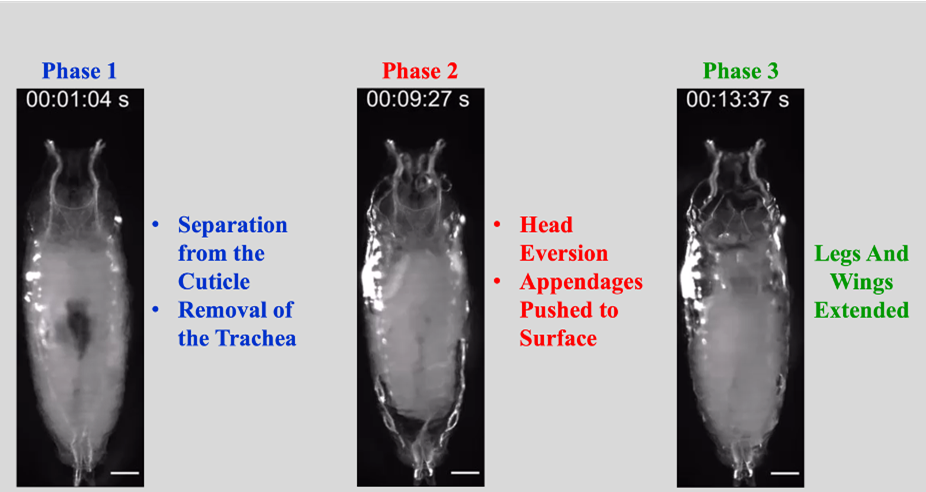
The Drosophila pupal ecdysis, a triphasic process, has provided a clearer understanding of such organized behaviors when examined. This process takes place inside the puparium, which is a protective casing formed by the larva prior to pupation. The entire sequence resembles a dance, coordinated with three separate parts. The first part of the dance starts with the bottom part of the insect lifting up over and over again, separating itself from the puparium. This is followed by movements that resemble body rolls that help prepare the insect for further transformation. In the second phase, the fruit fly accomplishes something amazing. The soon-to-be adult head and legs the larvae have been forming inside of its body are pushed out, effectively transforming its internal structures into external, functioning parts. While this is happening, the fly exhibits coordinated movements, including side-to-side swings and continued body rolls. Lastly, in the third phase, the wings and legs extend, completing the transformation.
One key element of this process is that these phases are always in the same order, making it a reliable behavioral sequence for scientists to study. Another benefit of studying pupal ecdysis in Drosophila is the fly’s nervous system can be removed from the body and kept alive. This allows scientists to more accurately observe what happens at the molecular level. When exposed to ETH the nervous system generates the full pattern of neural activity corresponding to the behavioral sequence of ecdysis, even in the absence of the body. This introduces the concept of the Central Pattern Generator (CPG) - a network of neurons that produces rhythmic, organized outputs to drive the activity of downstream motor neurons. Interestingly, the CPG neurons have bursicon receptors, and the motor neurons express the receptors for CCAP, thus ensuring coordinated transition of the CPG from the first motor program to the next. Hormones like ETH act not as simple triggers, but as signals that activate and modulate the several pupal ecdysis neural programs.
Adult Ecdysis
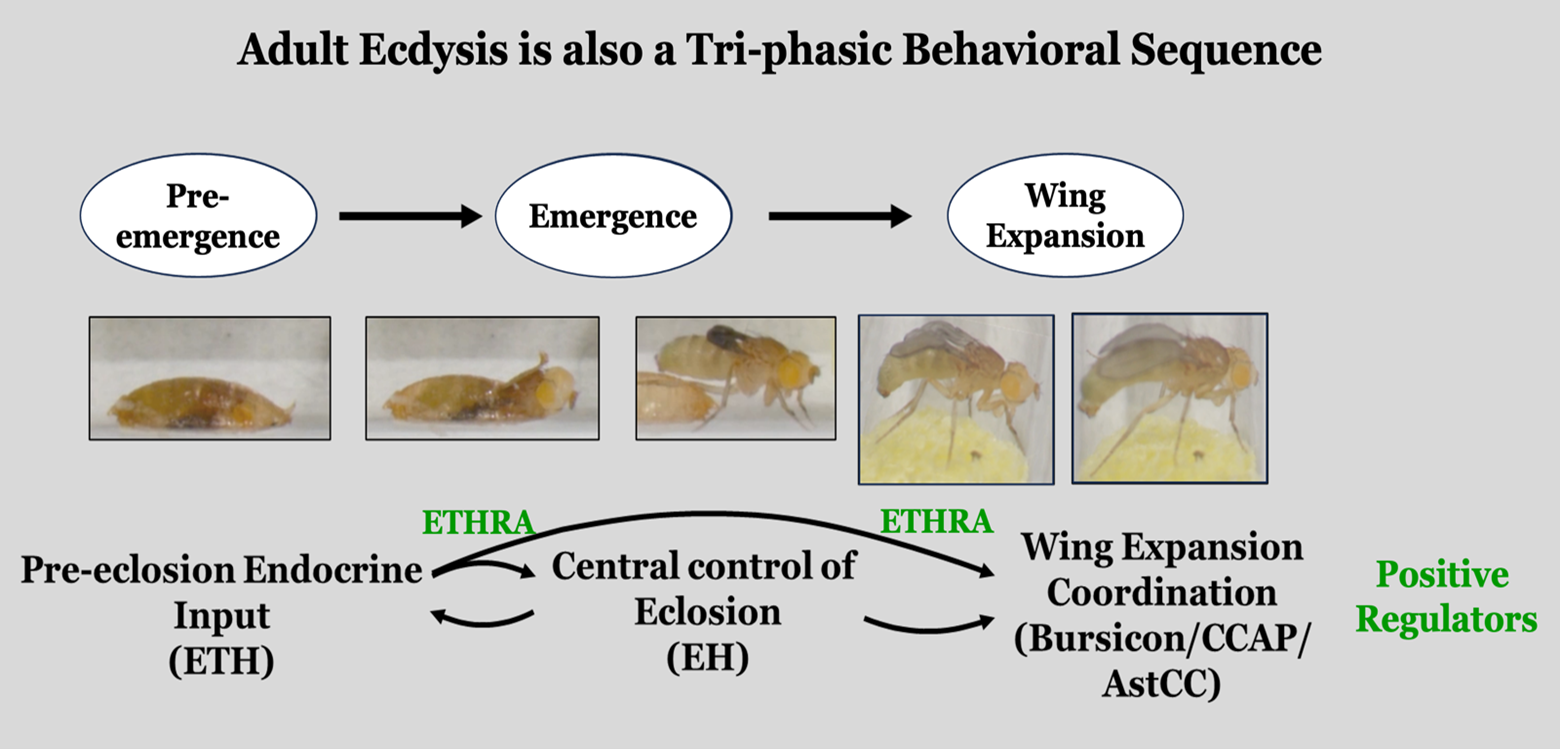
As the insect transitions into adulthood, the system becomes even more complex. Adult ecdysis is also organized into three distinct phases but involves different forms of regulation. Ecdysis Triggering Hormone Receptor A (ETHRA) and B (ETHRB) are the two receptors involved. ETHRA acts as a positive regulator, initiating and driving behavior. However, relying completely on positive regulation could trigger multiple behaviors at the same time, disrupting the process. This is where negative regulation becomes necessary to suppress certain behaviors until the appropriate time. The combination between initiation and suppression ensures that each behavior or phase occurs in the correct order. This results in a controlled progression of behaviors, which are all under the control of ETH in different ways, with the ultimate goal of adult emergence. ETH works very broadly throughout pupal and adult ecdysis, working through both positive and negative regulatory pathways.
A Shared Principle: From Fly to Mental Health.
The principles observed in Drosophila ecdysis go beyond insects. The process demonstrates a fundamental truth: hormones and other factors govern neural circuits, and neural circuits generate behavior. This principle applies across biology, from simple organisms to humans. Life relies on these neuronal regulations and motor programs required for task completion. Some behaviors must be activated, while others must be suppressed. When this balance is disrupted, behavior can become disorganized. This is where the connection to mental health emerges. While Drosophila ecdysis is inherently simplified and does not fully reflect the complexity of human neurobiological systems, it provides a useful model for understanding how internal signals regulate neural activity and behavior. It shows how global signals can be translated into multiple types of structured behavioral sequences and how both activation and inhibition are necessary for proper function.
What began as a journey from mathematics to biology ultimately leads to a deeper appreciation for how hormones and neurons control ecdysis in Drosophila and the ways such systems can be used to understand how the brain works.
Author bio:
Michael Adu-Brew is a graduate student working in the Krishnan Lab. His research focuses on assessing the risk of pesticides on non-target insects, particularly monarch butterflies.
References
- Elliott AD, Berndt A, Houpert M, Roy S, Scott RL, Chow CC, Shroff H, White BH (2021). Pupal behavior emerges from unstructured muscle activity in response to neuromodulation in Drosophila. Elife 10. https://doi.org/10.7554/eLife.68656.
- Sullivan LF, Barker MS, Felix PC, Vuong RQ, White BH (2024). Neuromodulation and the toolkit for behavioural evolution: can ecdysis shed light on an old problem? FEBS J 291, 1049-1079. https://doi.org/10.1111/febs.16650.