Co-written by Eileen Brandon and Lillian Buck
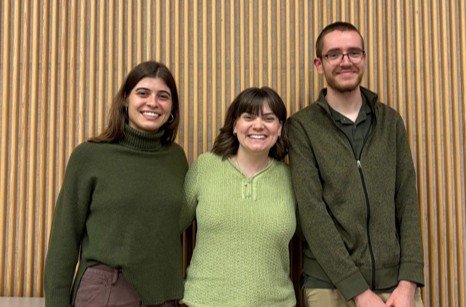
Research in progress (RIPS) talks are an opportunity for graduate students (Fig. 1) across the Entomology department to share what they are researching and answer questions. We had the pleasure of hearing from some of our stellar graduate students, for a deeper dive into some of their projects.
Jenan El-Hifnawi (PhD student) presents: signatures of southern Andean glacial refugia in Anthidium chilense
You may be familiar with the adorable faces of chinchillas and wild guinea pigs that are native to the Southern Andes, but did you know that this hotspot of global diversity hosts a wide range of flora and fauna including many types of bees? Many of these animals are understudied and at risk due to climate change and habitat loss.
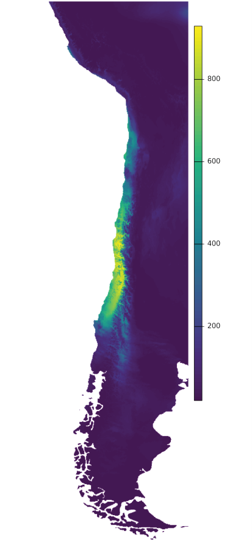
With a desire to understand the historical habitat of native bees and allow us to make predictions on where conservation efforts will be most effective, Jenan took on the task of studying the Chilean wool carder bee (Anthidium chilense). She began her research with the goal of modeling its historical range from the Pleistocene glaciations ( ~21,000 years ago) to the modern day. She used publicly available records of where the bees have been sighted to model the climatic preferences of the bees, and combined that with historic climate data to map how their suitable habitat range has changed over time. She found that during the last glacial maximum the suitable habitat for the bees appears restricted to three main areas that acted as a refuge during those frigid years (Fig. 2 center of yellow region). The central Chilean valley likely served as the primary refugium, while the other two suitable areas were north and southeast of this central region (Fig. 2 yellow fading to green). Figure 2 depicts the mean suitable habitat over the past several thousands of years. Other figures produced by Jenan demonstrate that the habitat for the Chilean woolcarder bee has likely since expanded further north and southeast from those three primary refuge areas. Jenan shared her findings at Entomology Society of America in November 2026 where she won 2nd place in the Systematics, Evolution and Biodiversity/Pollinators and Pollination session.
Jenan then used DNA samples of Chilean wool carder bees from the American Museum of Natural History (AMNH) in New York, and the Smithsonian Natural History Museum in D.C. to see if there are genetic signatures coming from being isolated thousands of years ago. She found that there are distinct genetic groups that are spatially restricted to the regions that she predicted using the historical climate data. She is going to continue developing these results to better understand these important pollinators as she begins her PhD.
This work will improve our understanding of the Chilean wool carder bee’s (Anthidium chilense) responses to climate change and identify centers of diversity to help inform appropriate conservation strategies. Additionally, Jenan is investigating if other bee and plant species in the region share similar responses to glaciations, potentially identifying glacial responses common to many taxa in this threatened and understudied region.
Daniel Davis (PhD student) presents: Whole-genome assembly and annotation of the acorn weevil, Curculio nanulus (Coleoptera: Curculionidae)
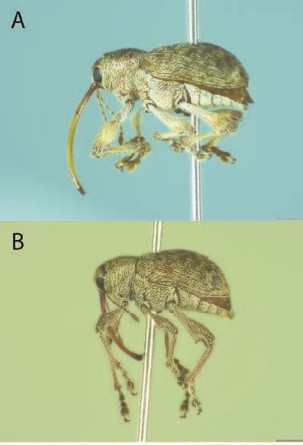
Many weevil species are pests of nuts, grains, and seeds. The acorn weevil (Curculio nanulus) uses its distinctive elongate mouthparts (rostrum; Fig. 3) to drill through the shells of acorns and hickory nuts to lay its eggs safe from the outside world. Once hatched the grubs will feast on the inside of the nut or seed. Later they will then chew their way out of the seed and burrow down into the soil where they will pupate and lay dormant, sometimes for many months. This period of dormancy, or diapause is what allows acorn weevils to take advantage of periods of high acorn production. Oak trees vary in the amount of acorns they produce year to year, synchronizing with other oak trees in the area to produce high (mast) and lower (non-mast) seed yields. The oak trees do this in an attempt to avoid their seeds from being attacked by seed predators as most insects have a one year life cycle. Non-mast years limit the number of seeds predators can lay their eggs in, keeping numbers lower. Diapause allows for acorn weevils to emerge as adults when seeds are plentiful. Genomic data can give researchers a clue as to the evolutionary history of an organism. To better understand this co-evolutionary relationship between oak trees and acorn weevils, Daniel Davis sequenced the genome of the acorn weevil, Curculio nanulus.
To start, Daniel captured a small sample of weevil grubs from the acorns of oak trees growing in Provo, Utah. He then sequenced the genome of one grub and allowed the rest to pupate and become adults. The larvae were maintained in coconut coir substrate where it took approximately 5 months for adults to emerge. Raising the weevils to adulthood allowed the insect to be identified to species.
The genome revealed that C. nanulus has a lot of repeating sequences which made the genome of this species very large compared to other weevils, about 1.5 Gbp (gigabase pairs) (Davis et al. 2026) which is almost twice as large as other previously sequenced weevil genomes such as the Asian Palm weevil (Rhynchophorus ferrugineus) at 0.8 Gbp. The human genome is approximately 3.2 Gbp. These repetitive sequences in comparison to other weevil genomes showed that the genome had grown in size relatively recently. Much of this growth was from the presence of many repetitive elements, which are sequences that have been duplicated in the genome. Some of the most common types of repetitive DNA sequences include transposons, retrotransposons, and satellite sequences. Transposons and retrotransposons, also called jumping genes, are DNA sequences that are copied and moved around the genome. Satellite sequences are typically noncoding repetitive sequences important for gene location and chromosomal structure. These repetitive elements could have an influence on the regulation of other genes that make protein products which control things like hormone signaling, metabolism, and life cycle. All of which are important in things that influence diapause in the acorn weevil. Sequencing the genomes of different species is important for seeing how they adapted to their environment at the molecular level. By understanding the molecular mechanisms of how species evolve, scientists can develop a deeper understanding of pest and host coevolution and develop tools for pest management that can target specific weaknesses in pest species or enhance host species.
Logan Lott (Masters student) presents: Drag, Collect, Detect: Tracking Tick Risk Across Maryland
Many people know about the threats posed by ticks: from Lyme disease, to Alpha-Gal syndrome, to Rocky Mountain Spotted Fever, there are a number of diseases that are spread by these arachnids. Logan Lott studies the life cycle, spatial distribution and pathogen prevalence of deer ticks (Ixodes scapularis) in Maryland, so you can know where to go on your next hike.
Logan’s research begins with the question, where do ticks hangout? To answer this question requires an understanding of their life cycle. A ticks life can begin on a forest floor or a grassy meadow, and their reproductive success depends on whether or not they can find a host. These hosts may be a bird or mammal such as a deer or human.To find a host to feed from, the tick will climb to the top of a blade of grass of foliage and wave their forelimbs, a behavior called questing. Their forelimbs have specialized sensory hairs called setae that allow them to know if a host is near. When a host is detected the tick will climb on to the host and search for a dark place where it is unlikely to be disturbed as it feeds. A tick must have a blood meal between every instar, or growth stage, and it can grow through multiple instars to reach its full maturity after about 2 years. Their need for multiple hosts is why they are vectors of disease. If a tick encounters an organism with a pathogen, the tick can carry that pathogen to its next host. Logan led a team of UMD undergraduates (E. Murphy, H. Sunder, S. Zachariah, R. Smith, and J. Kang) from May to September 2026 to monitor tick abundance in Maryland parks testing a previously developed tick habitat suitability model.
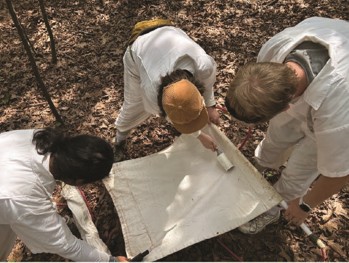
Dr. Grace Hummell, a former lab member in the ASWEL Lab, developed the model by considering biotic and abiotic factors to predict tick habitat. Biotic factors are living attributes of a particular research site, things like the animals the ticks feed on and the type of foliage that is present. Abiotic factors are nonliving attributes of the landscape, like humidity, temperature, and geography. To test this model, Logan collected ticks from 24 sites across 6 parks in Montgomery, Prince George’s, and Baltimore counties. She did this by dragging a white cloth along the ground for 200 meters per site, picking up any questing ticks. She then collected the ticks off the sheet and tested them for certain pathogens common to deer ticks.
Her results are currently being analyzed and considered in the construction of future models. This research is ongoing with the goal of developing a predictive model that could be used to identify areas that need more tick-focused land management. A model for predicting hotspots of high tick populations is important for prevention and management of tick borne illnesses in Maryland and potentially throughout the United States.
About the authors:
Lillian Buck is a second year PhD student being co-advised by Dr Karin Burghart and Evan Economo. Her research focuses on insect community composition in disturbed landscapes.
Eileen Brandon is a first year Master’s student being advised by Dr Leslie Pick. She studies segmentation genetics in the Large Milkweed bug.
References:
Daniel D Davis, Michael A Charles, Duane D McKenna, Paul B Frandsen, Whole-genome assembly and annotation of the acorn weevil, Curculio nanulus (Coleoptera: Curculionidae), G3 Genes|Genomes|Genetics, Volume 16, Issue 2, February 2026, jkaf292, https://doi.org/10.1093/g3journal/jkaf292