Tomatoes sit at the heart of modern cuisines around the world, from gazpacho in Spain to pasta al pomodoro in Italy and tikka masala in India. The tomato’s many varieties and flavors connect cultures through food. Beyond the kitchen, tomatoes are a favorite of backyard gardeners, who can follow the plant’s entire life cycle from seed to fruit.
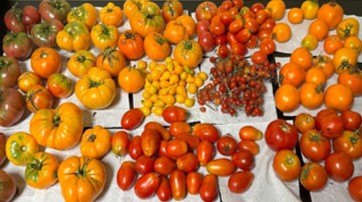
Common tomatoes that people encounter in grocery stores are bred to be tough. They need to survive shipping, ripen on a predictable schedule, resist pests and diseases, and produce a lot of fruit. Due to this, flavor is not always the top priority for store-bought tomato varieties. This is why the unique colors, impressive shapes, and expressive flavors of heirloom tomatoes (Figure 1) make them especially beloved. They are open-pollinated varieties, meaning pollination is done naturally by wind, insects, birds, or by the plant pollinating itself. As a result of this, if heirloom tomatoes are pollinated by the same variety and seeds are properly stored, they can produce offspring identical to the parent year after year, making their performance predictable and flavors reliable. However, there is a catch, as current heirloom tomato varieties are often prone to disease from insect pests, low yields, and drought sensitivity. These challenges matter for farmers who depend on their harvests for their livelihood and for backyard growers who are counting on every single plant.
Dr. Daniel Rodriguez-Leal (Figure 2) is an assistant professor in the Department of Plant Science & Landscape Architecture at the University of Maryland and leads the TomatoLab@UMD. He and his team of graduate and undergraduate researchers are interested in giving heirloom tomatoes some upgrades by editing their genes. His lab does this by using a molecular technique called CRISPR-Cas9, which acts as a “find and edit” function within an organism’s DNA. His team is able to pinpoint a specific gene, or set of genes, and tweak them. By targeting and editing the heirloom tomato DNA, one could create a variety that demonstrates increased fruit harvests and requires fewer pesticides and less water.
Gene editing is different from GMOs, or genetically modified organisms, because Dr. Rodriguez-Leal is not inserting foreign genes from another organism into the tomatoes. Instead, his team is editing genes the tomatoes already have. In fact, gene editing creates the same kinds of changes that breeders have always selected for, but in far less time. Instead of waiting through many generations of crosses to see if there are helpful random mutations, gene editing allows researchers to see results within a few growing seasons. His lab focuses on heirlooms particularly because they have been largely ignored by traditional breeding programs and biotech.

In a recent publication, Dr. Rodriguez-Leal and his team proved that CRISPR-Cas9 techniques can be used successfully on several heirloom varieties. During this experiment, they were able to improve the rooting ability of test plants. Both of these help with future work in the heirloom arena, increasing the success of desirable traits like flower production and fruit size. Nearly all the characteristics that make tomatoes better crops depend on genes that control plant growth. However, figuring out which genes control what traits is complicated; as Dr. Rodriguez-Leal says, “genes don’t play alone.”
The Tomato Lab focuses on a group of regulatory genes housed within the CLAVATA3/EMBRYO SURROUNDING REGION (CLE) gene family, which control other genes in a complex web of interaction. An overarching goal of the lab is to determine how these genes may affect plant growth regulation and development, which impacts fruit size, stem thickness, root growth, and salt and drought tolerance, qualities especially important for at-home or commercial growers. In our current age of climate instability, these traits are especially crucial as they can increase the overall strength and resilience of the plant during unpredictable conditions.
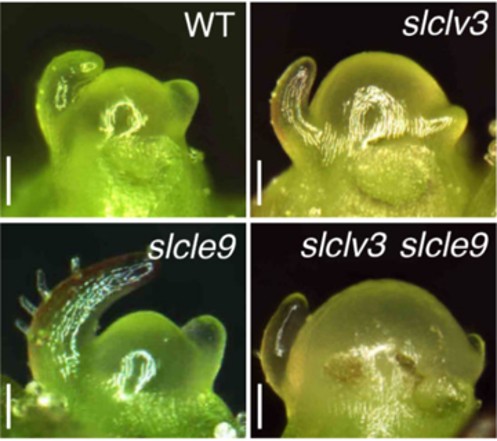
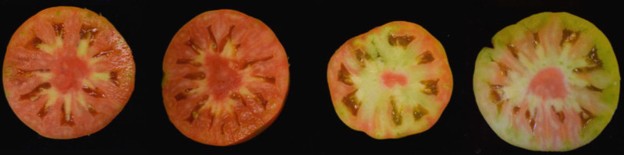
Dr. Rodriguez-Leal’s previous work has shown that two genes from the CLE family team up to affect stem thickness: SlCLE9 and SlCLV3. Figure 3 shows close-up photos of the shoot apical meristem, which contains plant stem cells. This stem cell niche is responsible for regulating growth of stems, leaves, flowers, and fruits. When SlCLV3 is mutated (edited to decrease its function), the meristem grows bigger, leading to thicker stems and larger fruits. Interestingly, single SlCLE9 mutants do not seem to have a larger meristem. However, when both SlCLV3 and SlCLE9 are mutated in the same plant, results show a very large meristem, suggesting that SlCLE9 is partially compensating for the lack of SlCLV3 function. These results indicate that meristem regulation is tightly controlled by the interaction of these two CLE genes and their teamwork in the tomato genome.
The Tomato Lab has recently discovered that SlCLE9 is somewhat of an overachiever and plays another role in plant development, particularly in the response to drought, suggesting this gene has evolved to regulate other processes in tomatoes. Their publication on this research is currently under review, but preliminary results have been promising, suggesting that in addition to stem growth control, another function of SlCLE9 could be positive regulation of root growth. Discovering how CLE genes interact with the rest of the tomato genome will also result in a better understanding of plant growth regulation in general, leading to advancements in fundamental science and understanding.
From their research, it’s clear Dr. Rodriguez-Leal and his team at the TomatoLab@UMD are set on improving the world of tomatoes, not only for commercial growers, but also for scientists and backyard gardeners (Figure 4). It may take plenty of time and energy, but their lab is dedicated to untangling the mysteries of heirloom tomato genes and keeping the heirloom’s future looking ripe!
About the Authors:
Logan Lott is a second-year master’s student in the Department of Entomology in the Megan Fritz Lab and A-SWEL Lab. She is currently working on how tick ecology, habitat characteristics, and human behavior interact to shape the spread of tick-borne diseases in Maryland.
Sabrina Purtee is a first year master’s student under Dr. Niranjana Krishnan in the Insect Pesticide Toxicology Lab studying the low-dose effect of pesticides on the physical and molecular process of ecdysis. See more about the lab and their research here.