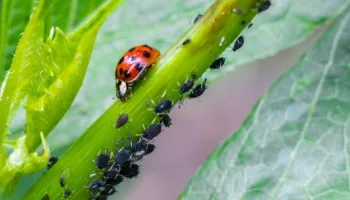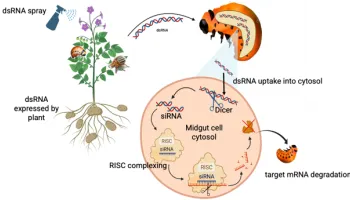
Biological control is usually described as the use of natural predators or enemies to control pest populations. Through a carefully planned, tested and regulated process, scientists sometimes introduce natural enemies such as predators, parasitoids or pathogens to attack harmful insects. But nature does not always wait for scientific approval. So, what happens when a natural enemy arrives on its own? And what happens when scientists misidentify or struggle to identify exactly what species have arrived?
Dr. Matt Buffington has encountered many instances of "accidental" biological control while serving as a Research Entomologist for the USDA Agricultural Research Service. Dr. Buffington studies parasitoid wasps in the superfamilies Platygastroidea and Cynipoidea. These wasps lay their eggs on or in the bodies of other insects, eventually killing their host as the wasp egg hatches and the larva feeds on its host. Most are only ~1 mm long, black, and incredibly difficult to tell apart from one another. Dr. Buffington is one of the only people in the world with expertise in identifying these species, despite their important ability to control common pests. For example, one of Buffington’s focal species is the Samurai wasp (Trissolcus japonicus) which parasitizes the eggs of Brown Marmorated Stink Bugs(BMSB) - an infamous invasive agricultural and household pest.
Researchers were already rearing this wasp in quarantine with the intention to use it for biological control when the unexpected happened. Parasitoids emerging from sentinel egg masses of BMSB left out in the wild were identified as T. japonicus. It seemed as though T. japonicus had escaped its quarantine, leaving Buffington and his team wondering how such an escape could be possible, and what the impacts would be. In another twist, DNA sequencing proved no such escape had occurred – the individual caught in the wild was genetically distinct from the quarantine population. This meant that T. japonicus arrived independently from Asia. Considering these wasps are only ~1 mm long, this is an unthinkable journey to accomplish through flight. It’s likely that the eggs or larvae of the parasitoids hitched a ride inside their hosts, which were hidden in plant stems, soil, fruits, or other agricultural materials as they were shipped overseas. Once the parasitoid emerges, it’s set up for success. With an invasive host and no other natural enemies in the area, the parasitoid is likely to successfully establish in what’s called a “secondary invasion”.
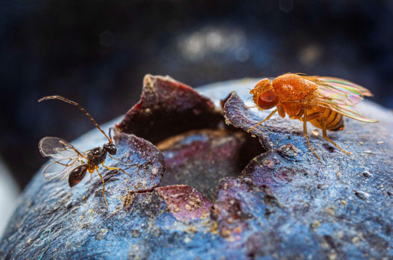
In this case, it’s incredibly fortunate that the exact species that researchers identified as an effective biocontrol agent is the one involved in a secondary invasion. Sometimes, we aren’t so lucky. Recently, Dr. Buffington has focused on wasps which parasitize the invasive spotted-wing drosophila (Drosophila suzukii), which costs fruit growers millions of dollars each year. Dr. Buffington and his colleagues had determined that the wasp Ganaspis kimorum was the ideal biocontrol candidate due to its extreme specialization on spotted-wing drosophila – it only parasitizes this single species. Unfortunately, before Buffington and his team could establish G. kimorum, a different non-native wasp beat them to it. Leptopilina japonica independently colonized much of the spotted-wing drosophila’s range. While it too is a parasitoid of the spotted-wing drosophila, it is less effective and targets multiple Drosophila species, putting native species at risk. It also seems to foil Dr. Buffington and colleagues’ plan for intentional biocontrol, as L. japonica appears to prevent the establishment of G. kimorum wherever it occurs. Differences in life cycle, habitat preference, host preference, and many other traits shape the role a wasp will play in a new environment, making it essential to import only the ideal species.
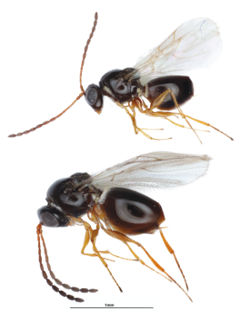
However, to import the ideal species, researchers must correctly identify the wasps to species. Mixing them up could be disastrous. If an invasive parasitoid is misidentified as a native one, scientists may conclude that the native parasitoid is controlling the pest and subsequently base all biocontrol strategies on that native parasitoid. Perhaps they would rear the wrong species, wasting precious time and resources. Attempts to predict the suitable range of the pest and parasitoid to determine regions of overlap would result in inaccurate conclusions about the parasitoid’s range. These are only two examples of many which show the importance of accurate identification. Unfortunately, even experts often struggle to identify a specimen to species – especially when the boundaries between species are ambiguous. Defining species can be contentious and philosophically complex, but regardless of one’s preferred species concept one problem continues to emerge: Taxonomic drift.
Taxonomic drift refers to the gradual change in what is understood to be the definition of a given species. Crucial to understanding taxonomic drift is the concept of type specimens. A type specimen is the representative individual of its entire species. When a species is discovered, an individual of that species is to serve as the physical representation of the species concept. Then, when another scientist identifies a specimen to be that species, they can consult the type specimen to confirm that their specimen is similar enough.
As many scientists abandon the practice of consulting types, an increasing fraction of records in global databases are misidentified and listed under inaccurate identifications: they are not the same species as their type specimen. As more records of this new, different species accumulate under the wrong name, the true definition of the species becomes fuzzy. If 99% of records match the type specimen and 1% are different, it is clear that the definition of the species still aligns with the type specimen, and one entry is an obvious error. But what if there are more erroneous specimens than correctly identified ones? Dr. Buffington believes that for some species, the vast majority of public records are actually a different species than the type specimen. If 99% of records don’t match the type specimen, should taxonomists conclude that a species definition has drifted away from its original meaning? If so, what does that mean for the type specimen? While some of these questions have no easy answer, Dr. Buffington reminds us that there is a fairly easy answer to preventing further taxonomic drift: consult the type specimens! Maintaining access to type specimens – and expert taxonomists to consult - is necessary to ensure that scientific data remain accurate and comparable over time. Unfortunately, the field of taxonomy is threatened by a consistent decline in funding. While it may be hard to imagine how the preservation of a single wasp collected ~100 years ago is necessary to fight against invasive species, Dr. Buffington’s work is one of many examples of the importance of taxonomy to all of us.
Authors:
Jenan El-Hifnawi is a 4th year PhD student in the Espíndola lab studying the impact of Ice Age glaciations on the evolution of southern Andean biota.
Michael Adu-Brew is a 4th year PhD student working in the Krishnan Lab. His research focuses on assessing the risk of pesticides on non-target insects, particularly monarch butterflies.
References:
- Mertl, M. (2002, May 22). Taxonomy in danger of extinction. Science. https://www.science.org/content/article/taxonomy-danger-extinction
- Sosa-Calvo, J., Forshage, M., & Buffington, M. L. (2024). Circumscription of the Ganaspis brasiliensis (Ihering, 1905) species complex (Hymenoptera, Figitidae), and the description of two new species parasitizing the spotted wing drosophila, Drosophila suzukii Matsumura, 1931 (Diptera, Drosophilidae). Journal of Hymenoptera Research, 97, 441-470.
- Stahl, J. M., Wang, X., Abram, P. K., Biondi, A., Buffington, M. L., Hoelmer, K. A., ... & Daane, K. M. (2024). Ganaspis kimorum (Hymenoptera: Figitidae), a promising parasitoid for biological control of Drosophila suzukii (Diptera: Drosophilidae). Journal of Integrated Pest Management, 15(1), 44.
- Talamas, E. J., Johnson, N. F., & Buffington, M. (2015). Key to Nearctic species of Trissolcus Ashmead (Hymenoptera, Scelionidae), natural enemies of native and invasive stink bugs (Hemiptera, Pentatomidae). Journal of Hymenoptera Research, 43, 45-110.