Ticks are known for their ability to transmit a multitude of diseases, and you probably wouldn’t allow them onto a carousel – unless you happen to be Dr. Hailey Luker. As part of her doctoral research, Dr. Luker developed a novel Tick Carousel Assay to evaluate the efficacy of different tick repellants.
Repellents are substances that deter pests and may be applied to skin, clothing, or dispersed as airborne particles. The goal of a repellent, particularly in the case of ticks and mosquitoes, is to prevent them from biting a potential host. This is especially important in regions in which arthropod-vectored diseases are prevalent -- as diseases are transferred from the saliva of a biting arthropod upon taking a blood meal, a successful repellent can disrupt the interaction and prevent the spread of disease.
There are many ways to determine how an organism is repelled by a compound, and each method comes with its own benefits and drawbacks. Dr. Luker addresses these in a 2024 review article1, in which she provides an extensive critical review of the current methods used to test mosquito repellents. Repellency assays most commonly involve an attractant stimulus, such as a live host or a moving object. An attractant serves to draw in the organism being assessed. The ability of a repellent to push away the organism even in the presence of an attractant can then be evaluated. However, existing repellency assays that utilize live hosts typically come with many regulations and high costs. Field-testing is often done to evaluate repellents in outdoor conditions, and although they provide useful information, they are difficult to replicate due to uncontrollable environmental variables. Presented with these drawbacks, Dr. Luker set out to develop an affordable and standardized laboratory assay that could serve as an alternative to similar assays done in the field.
Creating the Tick Carousel
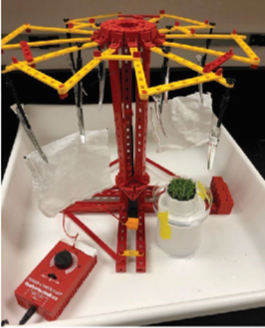
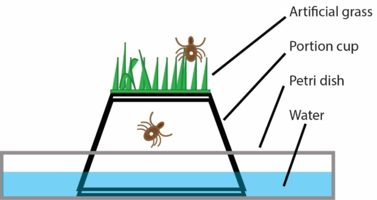
Dr. Luker used a FischertechnikTM construction kit to build the main component of the Tick Carousel Assay (Figure 1). She hung squares of fabric from the top of the carousel with clips and as the device rotated, the fabric squares brushed against a tick island (Figure 2). This set up emulates flagging, a common method used in field-testing that involves dragging a large section of fabric across vegetation to collect ticks. To provide an attractant stimulus, Luker would sit in front of the tick island and exhale onto the fake grass. This initiates host-seeking behavior in the ticks, which involves the use of a specialized organ (called a Haller’s Organ). Located on a ticks’ first pair of legs, this organ allows them to “smell” olfactory cues, such as exhaled carbon dioxide. They will seek out potential hosts by waving these adapted legs around in a manner referred to as ‘questing’.
The next step was to get ticks onto a “Tick Island”. This was a task easier said than done – Dr. Luker tested a total of three tick species, and found interesting but unfortunately incompatible traits in the behavior of all but one of them. While the other species tested often burrowed into the fake grass and rarely interacted with the fabric squares, the lone star ticks (Amblyomma americanum) were far more responsive and aggressive, proving to be the most suitable choice for the assay.
Evaluating the tick carousel assay’s ability to measure repellency was a crucial last step of the development process, as it would demonstrate its potential benefits and uses in future tick repellency research. This was done by treating the fabric squares with commercially available tick repellents that had proven repellency. As anticipated, there were significantly less ticks that clung onto the treated fabric than compared to untreated fabric. By combining moving-object and live host stimuli, Luker was able to successfully create a new laboratory method for assessing tick repellents.
Repellency of Essential Oils and Future Directions
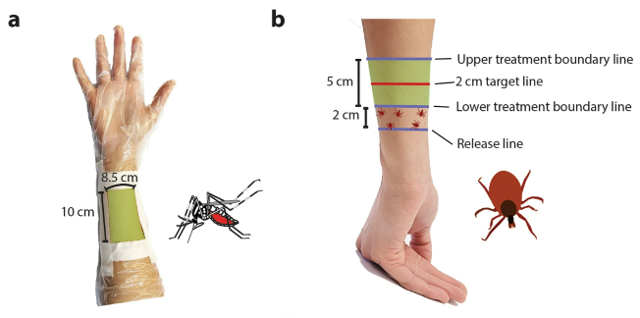
In a study using two contact-repellency assays, Dr. Luker analyzed how well different essential oils repelled mosquitoes and ticks3. These assays measured the amount of time that a repellent remained effective for. The mosquito arm-in-cage assay had a volunteer insert their arm in a cage containing mosquitoes, and the time taken for the first bite to occur was recorded (Figure 3a). The tick-on-arm assay had ticks placed near the base of a volunteer’s arm and measured the time taken for a tick to cross the treatment boundary line (Figure 3b). The essential oils tested were selected from a list of minimum risk pesticide ingredients published by the Environmental Protection Agency (EPA), as many of the ingredients on this list hadn’t been assessed for their repellency abilities. Formulations of repellents that use ingredients not on this list must be federally registered, which is an expensive ordeal. Businesses are able to save time and money when producing new repellents by sticking to this list of minimum-risk ingredients. Luker found that many of the essential oils tested showed effective levels of repellency for both ticks and mosquitoes, such as clove and cinnamon oil.
With the ongoing and persistent health threats from tick-borne illnesses, it is critical to understand how repellents work and continue the search for additional repellent compounds. Now working as a post-doctoral research fellow at the Johns Hopkins University School of Medicine, Dr. Luker has plans to continue her research in repellent essential oils by further identifying the components of the most effective essential oils, and determining which physiological factors may impact the duration and efficacy of their repellency.
About the Author
Luke Humke is a first year master’s student in the Krishnan Lab and is studying the metabolic adaptations in migratory monarch butterflies.
References
1. Luker, H. A. 2024. A critical review of current laboratory methods used to evaluate mosquito repellents. Frontiers in Insect Science, 4. https://doi.org/10.3389/finsc.2024.1320138
2. Luker, H. A., Rodriguez, S., Kandel, Y., Vulcan, J., & Hansen, I. A. 2021. A novel tick carousel assay for testing efficacy of repellents on amblyomma americanum L. PeerJ, 9, e11138. https://doi.org/10.7717/peerj.11138
3. Luker, H. A., Salas, K. R., Esmaeili, D., Holguin, F. O., Bendzus-Mendoza, H., & Hansen, I. A. 2023. Repellent efficacy of 20 essential oils on Aedes aegypti mosquitoes and Ixodes scapularis ticks in contact-repellency assays. Scientific Reports, 13(1), 1705. https://doi.org/10.1038/s41598-023-28820-9