
written by: Emma Hotchkiss
Controlling mosquitoes, the world's deadliest animal, is a difficult yet vital challenge. Dr. Cole Meier at Johns Hopkins University is studying new ways to kill and repel mosquitoes while reducing the chances of evolved insecticide resistance, with the goal of slowing the spread of mosquito-borne diseases for years to come.

Chemical insecticides are the most commonly used tool in managing insect pests, including mosquitoes. Most insecticides disrupt specific biological processes within the target pest. This specificity helps to protect non-target organisms, but also enables the evolution of resistance. Mutations can arise that detoxify the chemical, or physically block the chemical, preventing it from connecting with its specific target site. Evolved resistance makes insecticides less effective, necessitating higher doses and rotating in alternative chemicals that have different targets. In the face of evolved insecticide resistance, developing new methods of pest control is essential. Dr. Meier spoke to UMD Entomology about his research studying promising new methods of controlling mosquitoes that combat evolved resistance.
Photosensitive Insecticides (PSIs):
During his PhD, Dr. Meier investigated photosensitive insecticides (PSIs): chemical compounds that, upon interaction with light, produce molecules called reactive oxygen species (ROS). Unlike most insecticides that act on a particular target site, these molecules harm all cells indiscriminately. Because PSIs do not rely on a single target, evolution of resistance is less likely. Additionally, Dr. Meier demonstrated that PSIs degrade rapidly, so unlike most insecticides, PSIs do not persist in the environment.
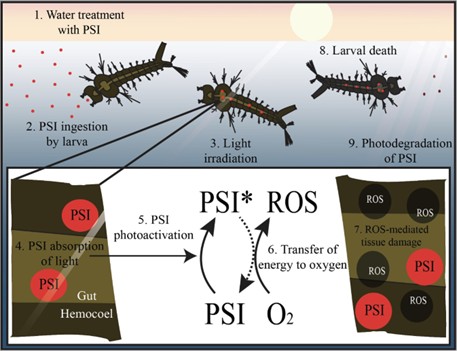
PSIs are primarily toxic when activated following ingestion, which can only occur if light can pass through the organism. Because mosquito larvae are translucent, PSIs can be added to water before sunrise, passively uptaken by the aquatic mosquito larvae, and activated when the sun comes up. The reactive oxygen species that result from this reaction, in high concentrations, kill the larvae (Figure 2). Larger, opaque organisms, including us humans, are unharmed because light cannot pass through our skin.
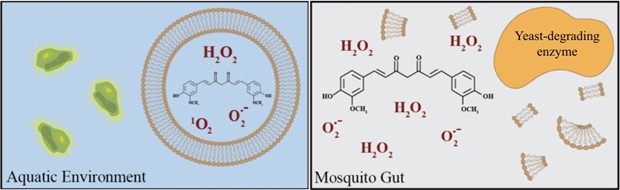
One remaining challenge is that many microorganisms are translucent, so PSIs can be toxic to them as well. To reduce impacts to microorganisms while also stimulating feeding in mosquito larvae, Dr. Meier explored encapsulating PSIs within yeast cells. Because mosquito larvae feed on yeast, their digestive system contains enzymes that break down these cells, releasing the PSIs inside (Figure 3). Yeast encapsulation increased PSI uptake in mosquito larvae, and is promising for helping to reduce non-target effects on microorganisms, although more work is needed to assess how well it performs across different PSI compounds and environmental conditions.
Like any new technology, extensive testing on the safety and efficacy of PSIs is necessary before implementation. The broadly toxic effects of PSIs, while ideal for preventing evolved resistance, also means that they may pose threats to a variety of aquatic life. Yeast encapsulation is one option in combatting non-target effects, but Dr. Meier emphasizes that more research needs to be done to ensure environmental safety. Additionally, PSI efficacy in water treatments also relies on the water being stagnant and penetrable by sunlight, so mosquito larvae in turbid water, indoors, or in very murky or algae-covered water would not be viable targets for PSIs.
Plant-Derived Mosquito Repellents:
Rather than killing mosquitoes, another method of disease control is to prevent mosquitoes from finding and biting people. Repelling mosquitoes, rather than killing them, can reduce contact with humans without exerting a selection pressure for resistance. Additionally, repellents could be used alongside current insecticides to reduce the number of mosquitoes interacting with the insecticide, slowing the evolution of resistance.
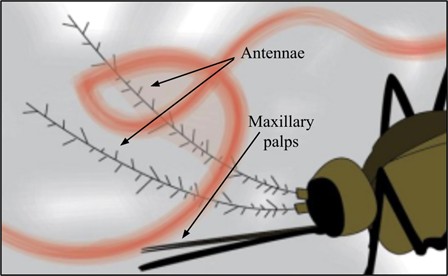
To develop effective mosquito repellents, researchers must first understand how mosquitoes sense the world around them. Mosquitoes have odorant receptors along their antennae and maxillary palps, which can smell different chemical compounds in their environment (Figure 4). Various plant extracts, such as those of lavender, lemongrass, and citronella, activate many of these receptors and seem to repel mosquitoes. The scent of humans, however, is often more appealing than these plant smells are repulsive, so these options do not reliably prevent disease spread.
Dr. Meier is currently working to figure out the specific plant-derived chemical compounds that drive mosquito repulsion, with the goal of developing more effective repellents that maximize activation of specific odorant receptors. By testing mosquito responses to individual chemical compounds, both in terms of their behavioral and their neurological responses, he aims to identify compounds that can effectively repel mosquitoes.
Dr. Meier’s innovative work underscores the complexity of mosquito control and the importance of developing new methods that remain effective long-term. Evolved insecticide resistance is one of society’s most pressing challenges, impacting our food systems along with human health. Finding new strategies to control pests without driving evolved resistance is vital for ensuring a more sustainable and healthier future for humanity.
*All figures in this article are adapted from Dr. Meier’s presentation

About the author: Emma Hotchkiss is a graduate student in the Hamby Lab researching corn earworm larval ecology and behavior in sweet corn. The Hamby Lab is an integrated pest management (IPM) lab dedicated to improving sustainability and efficacy of pest management in agriculture.
![[Seminar Blog] Perfume Flower Orchids Evolved Exceptionally Fast, Thanks to their Strange Pollinators](/sites/default/files/styles/16_9_350x200/public/articles/fall25seminar-blog_liu_fig-1_0.png.webp?itok=MtlUNt17)