
Pesticides of the future are precise, genetically targeted tools and insect-killing bacterial toxins that could offer robust protection to our crops -- if we use them wisely. Incautious use has left many pesticides less effective against their target pests due to the evolution of resistance. The natural variations within a population of pests produce some individuals that can survive certain pesticides. When a single pesticide is used too frequently, the survivors become the foundation of a new, resistant population. This is the principle behind pesticide rotation and stacking: no one individual is resistant to every pesticide, so the use of multiple types at once or in sequence can provide effective control of the population. A researcher at the University of Tennessee, Dr. Juan Luis Jurat-Fuentes, is piecing together how to slow the development of resistance to newer types of pesticides. His lab has two broad areas of interest: the toxins produced by the bacterium Bacillus thuringiensis (Bt) and RNA interference (RNAi).
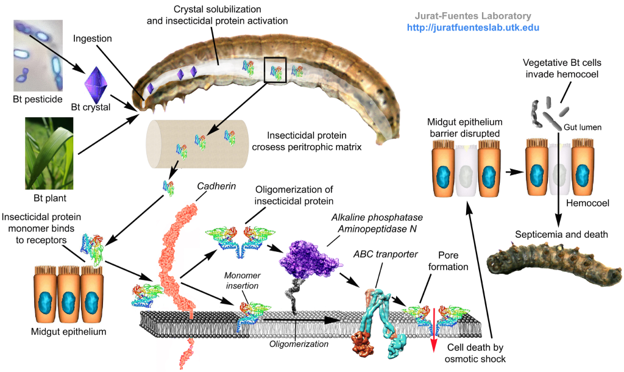
Bt is the older of the two technologies. Bt pesticides include mixtures of spores and parasporal Bt crystals that are made of Cry insecticidal proteins, which destroy the cell membrane of insects’ midgut cells (see image below). Crops like corn and cotton are frequently genetically engineered to produce Cry and Vip3Aa toxins from Bt, though pests are rapidly developing resistance.1 Resistance to Bt toxins often develops through a mutation in the gut protein which the toxin uses to bind and form a pore in the cell membrane. When the Bt toxin can’t bind to the cell, it passes harmlessly through the insect’s digestive system. Dr. Jurat-Fuentes’ lab works on developing highly sensitive, cost-effective, and fast molecular assays to detect the emergence of resistance and identifying the genes driving it. Their approach involves mass-genotyping hundreds of individuals across a population and characterizing the frequency at which resistance-associated genes are present. It can be more efficient than biological assays of the actual insects where one must rear the resistant insects and expose them to a pesticide.2 These molecular assays can also detect genes associated with resistance to other pesticides, not just Bt, as well as other relevant phenotypes (observable characteristics).
Even when pests develop resistance to a pesticide, there are always ways to circumvent them with new spins on an old tool. In addition to identifying and characterizing resistance to Bt, Dr. Jurat-Fuentes is improving the effectiveness of Bt toxins. There are three main approaches currently in development: redesigning the Bt protein, redirecting the Bt toxin binding site, and alternative delivery methods. In the first approach, a redesigned Bt protein may be constructed from several proteins, altered such that they bind more effectively to Bt’s conventional site or to a new site. In the second approach, Dr. Jurat-Fuentes has worked with the company IMPETUS AG to develop a redirected binding site method that uses an unaltered Bt protein and an adaptor molecule to promote binding to a different midgut site altogether. The adaptor molecule attaches to the Bt protein on one side and to a new protein on the target cell on the other side. Finally, in the third approach, a changed delivery method makes use of a minicell developed by the company AgroSpheres to bring the Bt to the midgut cell.
B. thuringiensis isn’t the only bacteria to produce insecticidal toxins. Entomopathogenic nematodes—tiny worms which parasitize insects—host symbiotic bacteria that help them kill and digest their insect prey. The many compounds that these symbiotic bacteria make to kill insects appear to work well as alternatives to Bt toxins. When a pest showed resistance to a Bt toxin, it was more vulnerable to the symbiotic bacteria toxins. This negative cross resistance opens the door to stacked pesticides or rotation practices that combine Bt toxins with novel toxins from these symbiotic bacteria.
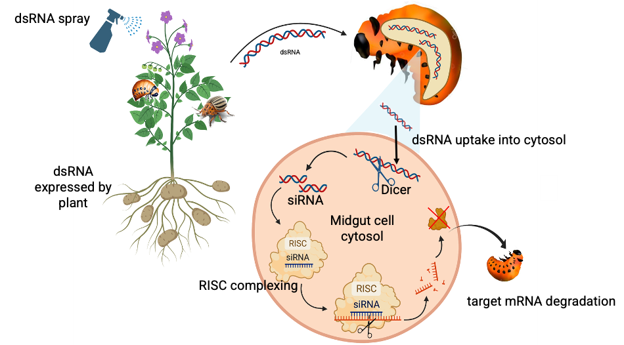
There are also entirely new tools coming to market: RNAi, discovered in 1998, is a newer and exciting pesticide option that Dr. Jurat-Fuentes studies. It acts by tricking a cell’s viral defense system into destroying a messenger RNA (mRNA) encoding for a protein that is vital to the insect’s life. (A quick refresher -DNA is transcribed into mRNA, then the mRNA is translated into a protein.) Typically, this viral defense system is triggered by the presence of double-stranded RNA (dsRNA), which normally is a sign of a viral invasion. To eliminate the virus by silencing the expression of its genes, the cell raises defenses and destroys all mRNAs that match the detected dsRNA. When a pesticide is built with the dsRNA version of an mRNA vital to the insect, those same mechanisms can be turned against the insect itself (see image below). By selecting the target mRNA carefully, a developer can create a pesticide that kills only one species. It would leave all other species that encounter it unharmed. dsRNA tools are coming to market against pests like the Colorado potato beetle, varroa mites, powdery mildew, fungal disease agents, and other vexing pests. Some dsRNAs even promise to suppress weeds.
However, evolution does not care if a pesticide is a chemical, a protein, or a dsRNA, and resistance to RNAi pesticides is of concern. Using laboratory selection, Dr. Jurat-Fuentes’ lab has seen resistance rise rapidly and persist without any apparent negative effects on the insect. Colorado potato beetles developed very high levels of resistance to RNAi swiftly.3 In an aphid species, resistance also increased more than 70-fold in just 10 generations.4 Multiple genes appeared to be involved in conferring resistance, and the resistance persisted even when the dsRNA was changed to target a different gene.
These early results are a warning that RNAi is not a magic bullet. It is a precious new mode of action among pesticides, but, like its predecessors, it can still be selected against. Dr. Jurat-Fuentes and other experts recommend that RNAi products need to be used cautiously and in rotation with other types of pesticides.5 Precautions like these can slow the development of resistance and extend the useful life of RNAi pesticides to realize their full potential.
This blog was written by Jillian Stewart, a master’s student in Dr. Niranjana Krishnan’s lab. They are studying monarch butterfly conservation in the context of a diamide pesticide and how it can affect monarchs in the field and the greenhouse.
More information:
Dr. Jurat-Fuentes’ website: https://juratfuenteslab.utk.edu/default.html
Another website on his research: https://utia.tennessee.edu/person/?id=5952
References
1. Reisig, D., Golsworthy, E., Kerns, D., Paula-Moraes, S., and Jurat Fuentes, J.L. 2026. First characterization of Vip3Aa resistance in beet armyworm (Lepidoptera: Noctuidae) collected from cotton expressing Vip3Aa19, Journal of Economic Entomology, 119 (1): 247–253, https://doi.org/10.1093/jee/toaf303
2. Farhan, Y., Ruttink, T., Abdelgaffar, H., Tandy, P., Lamour, K., Smith, J.L., and Jurat-Fuentes, J.L. 2026. New tools for an old pest: HiPlex targeted sequencing for Bt corn resistance screening in Ostrinia nubilalis (Lepidoptera: Crambidae) from Canada, Journal of Economic Entomology, toag248, https://doi.org/10.1093/jee/toag248
3. Mishra, S., Lamour, K., Emrich, S., Moar, W., and Jurat-Fuentes, J.L. 2026.
Reduced uptake through clathrin down-regulation is associated with resistance to dsRNA in a population of the Colorado potato beetle (Leptinotarsa decemlineata, Say),
Pesticide Biochemistry and Physiology, 216: 106783, https://doi.org/10.1016/j.pestbp.2025.106783.
4. Tariq, K., Haseeb, A., ul Haq, I., Jurat-Fuentes, J.L. and Ullah, F. 2026. Selection of resistance to dsRNA in the wheat aphid (Schizaphis graminum) without detectable fitness trade-offs, Pest Management Science, 82: 1023–1031, https://doi.org/10.1002/ps.70260
5. Narva, K., Toprak, U., Alyokhin, A., Groves, R., Jurat-Fuentes, J.L., Moar, W. et al. 2025. Insecticide resistance management scenarios differ for RNA-based sprays and traits, Insect Molecular Biology, 34(4), 518–526, https://doi.org/10.1111/imb.12986
![[Seminar Blog] Gold, God and Grubs: The Impact of Colonization on Insect Consumption in the US](/sites/default/files/styles/16_9_350x200/public/articles/ento_spring26blog_lesnik.jpg.webp?itok=OHEvg8Ia)
![[Seminar Blog] Director of the Entomological Society of America, Chris Stelzig, visits our department](/sites/default/files/styles/16_9_350x200/public/articles/ento_spring26blog_stelzig.jpg.webp?itok=mYHMLS0Q)
![[Seminar Blog] From Sweat to Supper: The Sensory Science Behind Mosquito Host Detection](/sites/default/files/styles/16_9_350x200/public/articles/seminar-blog_raji_fall25_pic-1.jpg.webp?itok=sE7-bgrW)