
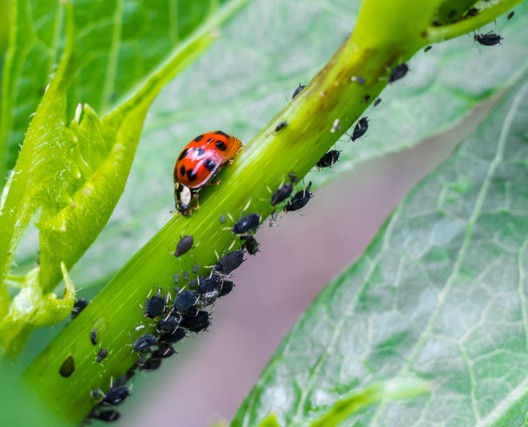
If you’ve ever had to deal with an outbreak of aphids on your plants, you understand the importance of pest management. You may have even purchased some commercially available ladybird beetles to eat those aphids. Aphids are a problem not just in gardens, but in large scale agriculture and commercial crops as well. As cool as this method of pest control is, scientists are discovering that predators can influence their prey in more ways than just direct consumption, or outright eating of the prey. Dr. Sara Hermann, Associate Professor in the Department of Entomology at Pennsylvania State University, researches a novel way of dealing with aphids by using their predators not to eat the pest, but to change their behavior to reduce their numbers in crops. These behavioral changes can lead to fitness costs known as “non-consumptive” effects and could present a new way of managing insect pests that has so far been overlooked.
In her talk titled "Signaled, Scared, and Surviving: Chemical Ecology Across Insect Predator–Prey Interactions," Dr. Hermann explains how her lab studies non-consumptive effects to manage green peach aphids, Myzus persicae. In the presence of a common predator, the harlequin ladybeetle, Harmonia axyridis, the aphid may react in ways that will reduce pest outbreaks. These reactions may include behaviors such as reduced growth, feeding, reproduction, or activity, as well as dispersal to new plants. All these changes result in lowered populations via reactions the prey is having to the predator beyond being consumed by it. If these reactions are significant, they can greatly reduce pest outbreaks.
To understand the influence predators have, we need to understand how their prey detect them. Insects avoiding predators are always on the lookout for potential danger, but in this case they’re on the smell-out. Dr. Hermann’s research focuses on those olfactory cues aphids detect from their predators. While releasing ladybeetles to eat aphids works well, they do tend to fly away. If producing their deterring smell without needing to wrangle a swarm of ladybeetles works, it would be a lot easier to control aphid pests. In a recent paper, her lab found that when ladybeetles were held in mesh cages, unable to reach and eat aphids but able to exude their smell, aphid feeding decreased. In a similar experiment, they saw wingless aphids decreased the amount of offspring they had when the only thing separating them from being dinner was a layer of mesh. These experiments emphasize those “non-consumptive” effects Dr. Hermann is interested in. If we can prevent aphids from producing as many offspring and feeding on our plants, we don’t need the ladybeetle to be able to reach and eat the aphids!
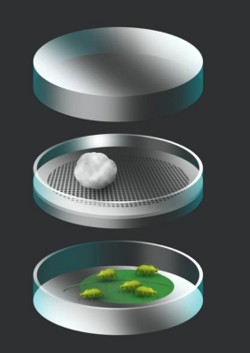
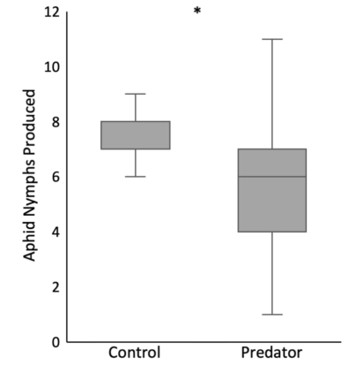
Though these results demonstrate the impact of the non-consumptive influence of predators, they don’t prove that the smell was what made the aphids lose their appetite. Dr. Hermann and her lab decided to take it a step further. If you’ve ever had ladybeetles invade your home, you will understand the distinctive smell they give off. Since the aphids were presumably responding to the ladybeetle smell, what would happen if they isolated that particular stench and tested how the aphids reacted, without the actual ladybeetle there at all?
Dr. Hermann and her lab took their experiment to the field to see if this smelly deterrent could be a practical solution for aphid pest issues. The initial results were promising - aphids were less likely to move into field plots hosed down with eau de ladybeetle, and the aphids that did had slower population growth than aphids on unscented plants. Combining what she found in the lab with reduced feeding and reproduction, predator scents could be a viable solution to reducing abundance of pests.
Of course, pest management is often more nuanced than simply making your plants stink. Dr. Hermann stated her belief that there is “no one great big thing that’s going to fix all our problems,” but remains optimistic about a future where we utilize the non-consumptive effects of predators to reduce pest problems. Novel, science-based approaches like what Dr. Hermann does could reduce the need for insecticides when used with other sustainable pest management tactics.
If this work interests you and you want to learn more, you can watch this PBS Insectarium episode starring Sara Hermann and her work.
Author: Maggie Schaefer is a graduate student in the Department of Entomology at the University of Maryland College Park.
Sources:
Kansman, J.T., Nersten, C.E., Hermann, S.L. Smelling danger: Lady beetle odors affect aphid population abundance and feeding, but not movement between plants. Basic and Applied Ecology, 71, 1-8 (2023) https://doi.org/10.1016/j.baae.2023.05.004.
Hermann, S.L., Bird, S.A., Ellis, D.R. et al. Predation risk differentially affects aphid morphotypes: impacts on prey behavior, fecundity and transgenerational dispersal morphology. Oecologia 197, 411–419 (2021). https://doi.org/10.1007/s00442-021-05037-z
PBS Terra. (December 18 2023). Pssst: Ladybugs Have a Killer Secret. [Video]. American Museum of Natural History. https://www.amnh.org/explore/videos/biodiversity/killer-ladybugs-help-sustainable-farming

![[Seminar Blog] The Present and Future of Bt GMOs, RNAi pesticides, and the Development of Resistance](/sites/default/files/styles/16_9_350x200/public/articles/entomology_fall26seminarblog_jarat_1.png.webp?itok=C4gCYLC7)
![[Seminar Blog] Gold, God and Grubs: The Impact of Colonization on Insect Consumption in the US](/sites/default/files/styles/16_9_350x200/public/articles/ento_spring26blog_lesnik.jpg.webp?itok=OHEvg8Ia)